
12 Hour Shift Schedule Comparison
Compare the common 12-hour rotations side by side: crews needed, weekends off, longest runs, hours a year and the overtime pay each one gives.
Free · runs in your browser · nothing is uploaded
How to use the 12-hour shift schedule tool
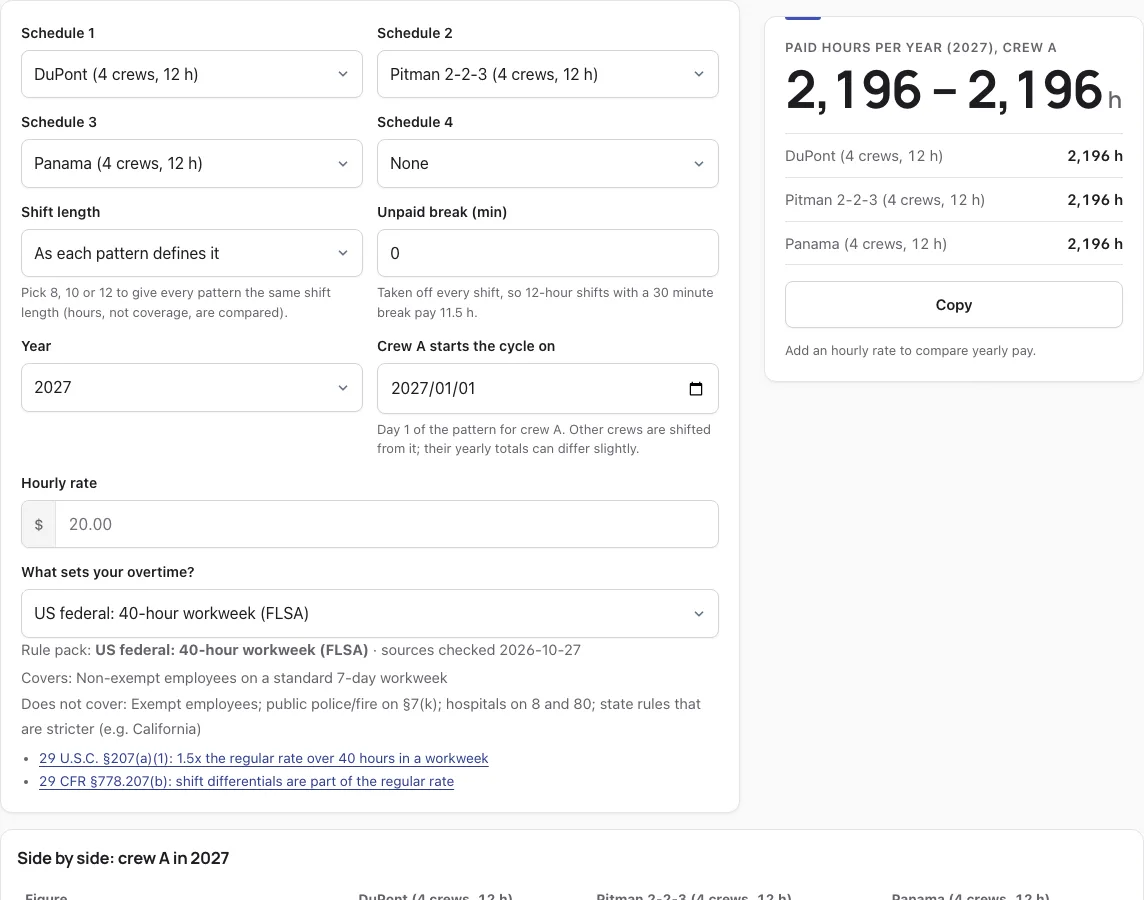
- Look at the first three patterns already loaded: DuPont, Pitman 2-2-3, and Panama, for 2027, with crew A starting on 1 January 2027.
- Use the four schedule menus (Schedule 1 to Schedule 4) to change any pattern. Choose None in slot 3 or 4 to compare fewer patterns. At least two must stay selected.
- Set Shift length. Keep “As each pattern defines it” for the usual 12-hour day and night shifts, or pick 8, 10 or 12 h to apply one length to every pattern.
- Enter an Unpaid break (min) if you want it taken off every shift, such as 30 minutes.
- Pick a Year from 2026 to 2030.
- Set Crew A starts the cycle on to change which day is day 1 of the pattern.
- Type an Hourly rate to see estimated gross pay.
- Choose a rule pack under What sets your overtime?
- Read the Side by side table, then the Assumptions and limits block before you act on any figure.
Every choice you make is kept in the page address, so copy the link to return to the same setup or share it with a colleague. To see one pattern as a dated month calendar for your own crew, open its own page, such as the DuPont or Pitman calendar, from the related tools below.
How does overtime work on a DuPont schedule?
Overtime on a DuPont schedule depends on the rule pack you pick, because the pattern averages 42 hours a week while many workweeks run over 40. The tool counts overtime over whole workweeks, and the federal 40-hour rule pays 1.5 times the regular rate for hours above 40 in a workweek.
The three patterns below were computed by the tool for 2027, with crew A, a $20 hourly rate, and the US federal 40-hour (FLSA) pack.
| Pattern | Paid hours in 2027 | Weekends fully off | Overtime hours | Estimated gross pay |
|---|---|---|---|---|
| DuPont | 2,196 | 50 % | 403 | $47,950.00 |
| Pitman 2-2-3 | 2,196 | 0 % | 208 | $46,000.00 |
| 4 on 4 off | 2,208 | 38 % | 208 | $46,240.00 |
Weekends fully off depend on the weekday each cycle starts. By default the comparison starts every pattern on 1 January 2027, a Friday, which puts Pitman’s 3-day blocks across Friday to Sunday only for some crews; crew A gets no fully free weekend from that start, while a Monday start gives every other weekend off. Change the cycle start date to match your site.
The California health care alternative workweek (12-hour) pack gives the same overtime and pay for these patterns. Its daily rule only matters when a shift passes 12 hours, and none of these shifts do, so only the weekly rule applies. Pay is an estimate with no differentials, premiums or public holidays. Contracts and union agreements can change the result.
How does an unpaid break change the paid hours?
An unpaid break comes off every shift, so the paid hours fall. With a 30-minute break on every 12-hour shift, each shift becomes 11.5 paid hours. For DuPont in 2027 the tool gives 2,104.5 paid hours, an average of 40.25 hours a week, 318.5 overtime hours, and an estimated $45,275.00 at $20 an hour. The average drops below 42 because the break is taken from each shift, not just from some of them.
More questions
Should we use fixed or rotating 12-hour shifts?
Fixed shifts suit staffing based on preference, where workers choose nights for a shift differential or daytime shifts for childcare. Rotating shifts spread night work across the whole team. The tool compares the rotating patterns, so it shows the hours and days off each one gives, not which type suits your team.
Can the DuPont schedule work for contact centers?
It can, because four crews cover every hour. Contact centers often follow call volume with 8- or 10-hour shifts instead, so check the staffing needs of your own queue before you adopt it.
Is the DuPont schedule good for work-life balance?
A full week off in every 28 days is the draw; the price is long shifts and three weeks that each contain night work. Compare the longest run of days off and the weekends fully off for DuPont with the other patterns before deciding.
Can three, four, or five crews cover continuous work?
Continuous work needs enough crews that the hours covered match the 168 hours in a week for each position. A pattern with an average of 42 paid hours needs four crews for one position. Three or five crews only fit when their average hours per crew match the cover you need, and the tool shows the crews needed and whether each pattern is 24/7.
How this tool works and where the numbers come from
Each rotation is expanded over the same dates and counted minute by minute. Overtime is applied per workweek or work period under the rule pack you pick, following the official texts below. Results are estimates, not legal or payroll advice.
Sources
- 29 U.S.C. § 207 (FLSA § 7): overtime after 40 hours a week; § 7(j) hospitals (8 and 80); § 7(k) fire and police work periods (U.S. Code, 2023 Edition) · checked
- 29 CFR Part 778: overtime compensation (regular rate, workweek) (eCFR current as of 2026-10-23) · checked
- 29 CFR § 778.105: the workweek is a fixed and regularly recurring period of 168 hours (eCFR current as of 2026-10-23) · checked
- 29 CFR § 778.207(b): shift differentials are part of the regular rate (eCFR current as of 2026-10-23) · checked
- California Labor Code § 510: daily overtime over 8 hours, double time over 12, seventh day (as amended by Stats. 1999, ch. 134, effective 2000-01-01) · checked
- California Labor Code § 500: workday, workweek and alternative workweek schedule defined (added by Stats. 1999, ch. 134, effective 2000-01-01) · checked
- IWC Wage Order 5 (public housekeeping incl. health care), section 3(B)(8): 12-hour health care alternative workweek (effective 2002-07-01 as amended; sections 4(A) and 10(C) republished effective 2019-01-01) · checked
- California Labor Code § 511: alternative workweek schedules (up to 10-hour days without overtime) (as amended by Stats. 2012, ch. 46 (SB 1038), effective 2012-06-27) · checked
- 29 CFR § 778.601: hospitals and residential care, 14-day period (8 and 80) (eCFR current as of 2026-10-23) · checked
- U.S. Department of Labor, Fact Sheet #23: overtime pay requirements of the FLSA (Revised October 2019) · checked
- California DLSE: overtime FAQ · checked
- California DLSE: overtime exceptions FAQ (alternative workweeks) · checked
- U.S. Department of Labor, Fact Sheet #54: health care industry and overtime (8 and 80) (Revised July 2009) · checked
Frequently asked questions
Why use 12-hour shifts?
Twelve-hour shifts mean fewer shift changes and handovers in a month, and each cycle includes longer blocks of days off than a schedule of eight-hour shifts usually gives. Employers use them to keep a site staffed around the clock with fewer people on the schedule at any one time.
What is a 12-hour shift?
It is one block of duty that lasts 12 hours, for example 07:00 to 19:00 or 19:00 to 07:00. The patterns in this tool use 12-hour day and night shifts by default, and you can override the length with 8, 10 or 12 hours.
What is a DuPont schedule?
DuPont is a four-crew rotation that repeats every 28 days and mixes blocks of nights, blocks of days and rest. Each crew has its own day in the cycle, so at any time one crew is on days, one is on nights, and the others are off.
Is it healthy to work 12 hour shifts?
Long shifts and night blocks are demanding, and the answer depends on the person, the workload and the rest between shifts. The tool does not measure fatigue or health. It shows the hours and days off each pattern gives, so you can judge the load for yourself.
How many people does continuous coverage require?
One position staffed around the clock needs 168 hours of cover each week. At an average of 42 paid hours per crew member, that works out to 4 crews, which is why the DuPont and 4 on 4 off patterns use four crews.
How many crews does a DuPont schedule need?
A DuPont schedule uses four crews. The tool lists it as “24/7 cover” with 4 crews, and the 28-day rotation covers every hour as long as the crews work their default shift times.
How many hours per week is a DuPont schedule?
A DuPont schedule averages 42 paid hours per week over its 28-day cycle. The exact total for a year depends on the calendar, so the tool counts the real shifts that start in the year you choose.
What is the longest break on a DuPont schedule?
The longest break is seven consecutive days off, which happens in Week 4 of the cycle. The tool also reports the longest run of days off for each pattern you compare.
Related tools
- DuPont schedule: the DuPont calendar and pay in detail, when you want to focus on one pattern.
- Pitman schedule: the Pitman 2-2-3 calendar and pay, when you compare it with DuPont.
- 4 on 4 off schedule: the 4 on 4 off pattern, when you want an eight-day cycle.
- 7 on 7 off schedule: the 7 on 7 off pattern, when long blocks of days off matter most.
- Panama schedule: the Panama pattern, when you compare cycle structures.
- Overtime calculator: a quick overtime check, when you want to test a single week.
- Shift calendar: a day-by-day view of shifts, when you need to plan dates.
- Work hours in a year: total annual hours, when you need a yearly baseline.