
4/10 Work Schedule Calendar
See the 4/10 schedule by date and what four 10-hour days mean for overtime under federal, California and alternative-workweek rules.
Free · runs in your browser · nothing is uploaded
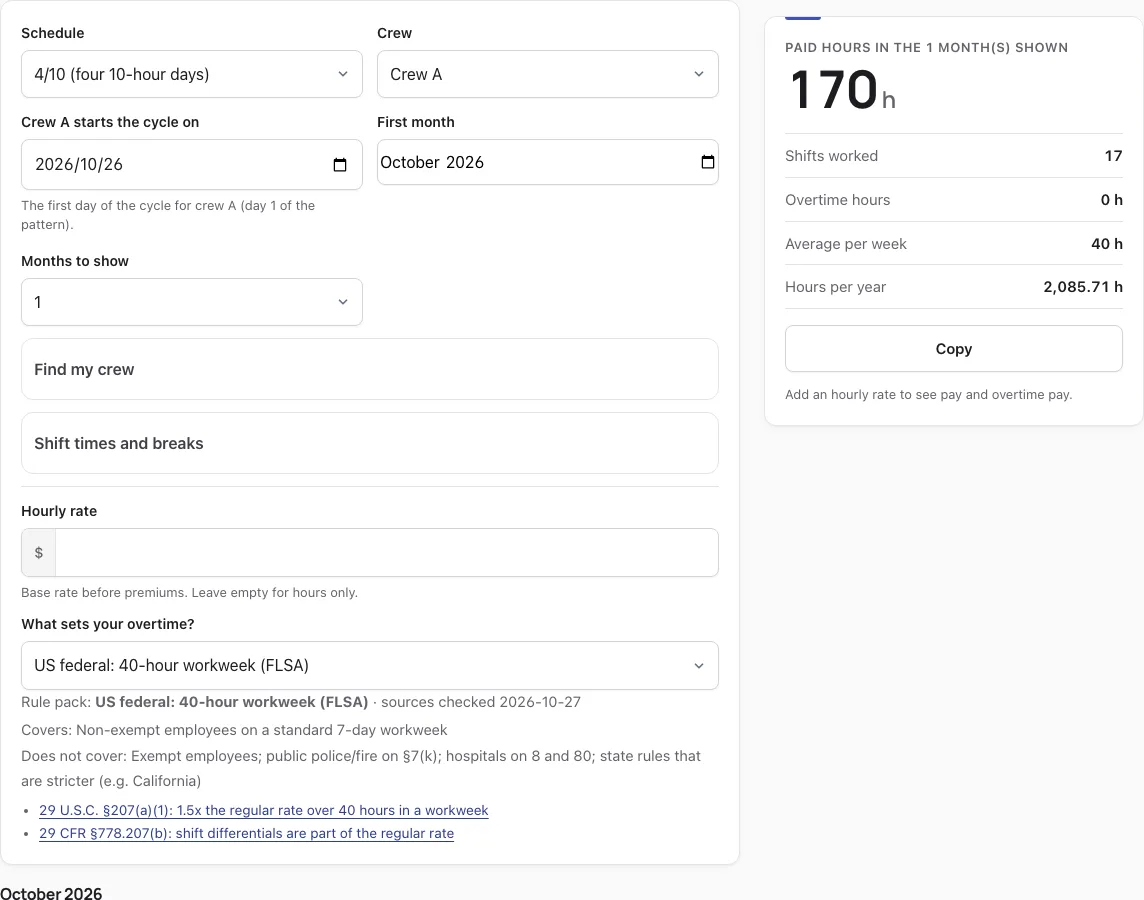
How to use the 4/10 Work Schedule Calendar
- Open the Schedule menu and select 4/10 (four 10-hour days a week).
- Open Crew and pick your crew (A, B, C or D).
- Enter the date in Crew A starts the cycle on. The other crews follow the same cycle, delayed by a fixed number of days.
- Set your clock start, end and unpaid break under Shift times and breaks. The hours and pay update from these times.
- Choose First month and Months to show to set the calendar range.
- Enter your Hourly rate, then pick a rule pack under What sets your overtime?
- Tap a day to record what really happened. On a work day, taps cycle through sick, vacation, off and swapped shift. On a day off, a tap marks a picked-up shift. These marks don’t change the rotation.
- Read the result card for paid hours, shifts worked, overtime hours and estimated gross pay.
Download calendar (.ics) adds one event per worked shift to Google, Apple or Outlook calendars, and Download CSV gives paid, regular and overtime hours and pay for each shift. Print outputs the calendar without the form. Your marks are stored only in this browser, and Clear my marks removes them.
What does a 4x10 work schedule mean?
A 4x10 work schedule means four 10-hour shifts in one workweek, which adds up to 40 hours. It is a compressed workweek, so employees get a fixed day off each week in exchange for longer shifts. In this tool’s 4/10 pattern, each crew works four of every seven days, and the longest run is four days on followed by three days off.
Do I get overtime on a 4/10 schedule?
Usually not under the federal rule. Under the FLSA 40-hour workweek, a 4/10 schedule totals exactly 40 hours, so no weekly overtime is triggered. The worked example below uses four weeks of Crew A from 1 Nov 2026 at $30 an hour.
| Rule pack | Shifts | Paid hours | Overtime hours | Estimated gross pay |
|---|---|---|---|---|
| US federal 40-hour workweek (FLSA) | 16 | 160 | none | $4,800.00 |
| FLSA 7(k) fire (212 h in 28 days) | 16 | 160 | none | $4,800.00 |
Each Monday-to-Sunday week in that window works out the same way:
| Week | Shifts | Paid hours | Overtime hours |
|---|---|---|---|
| Week 1 | 4 | 40 | none |
| Week 2 | 4 | 40 | none |
| Week 3 | 4 | 40 | none |
| Week 4 | 4 | 40 | none |
California counts each day as well as each week. Under the California default pack every 10-hour day has 2 hours over 8, so the same four weeks give 32 overtime hours at 1.5x and an estimated $5,280.00. Under the California alternative workweek (10-hour) pack, which applies only where a 4/10 schedule was adopted by a secret-ballot vote, the 10-hour days carry no daily overtime and the estimate stays at $4,800.00.
What happens if I work 5 days on a 4/10 schedule?
Hours on the fifth day count toward the week’s total. Under the federal rule, once you pass 40 hours in a workweek, those hours are overtime and are paid at 1.5 times your rate. To model this, tap an off day to mark a picked-up shift. Under the federal pack it counts toward the 40-hour week. Under the California 10-hour alternative workweek pack the fifth day is outside the adopted schedule, so its first 8 hours are paid at 1.5x and any hours over 8 at 2x (DLSE overtime exceptions FAQ). For a rule from your own contract, use the Overtime Calculator custom editor.
How this tool works and where the numbers come from
The calendar repeats the rotation from your crew’s start date and counts every shift minute by minute. Overtime and pay are worked out over whole workweeks (or the 7(k) and 7(j) work periods) under the rule pack you pick, following the official texts below. Results are estimates, not legal or payroll advice.
Sources
- 29 U.S.C. § 207 (FLSA § 7): overtime after 40 hours a week; § 7(j) hospitals (8 and 80); § 7(k) fire and police work periods (U.S. Code, 2023 Edition) · checked
- 29 CFR Part 778: overtime compensation (regular rate, workweek) (eCFR current as of 2026-10-23) · checked
- 29 CFR § 778.105: the workweek is a fixed and regularly recurring period of 168 hours (eCFR current as of 2026-10-23) · checked
- 29 CFR § 778.207(b): shift differentials are part of the regular rate (eCFR current as of 2026-10-23) · checked
- California Labor Code § 510: daily overtime over 8 hours, double time over 12, seventh day (as amended by Stats. 1999, ch. 134, effective 2000-01-01) · checked
- California Labor Code § 500: workday, workweek and alternative workweek schedule defined (added by Stats. 1999, ch. 134, effective 2000-01-01) · checked
- IWC Wage Order 5 (public housekeeping incl. health care), section 3(B)(8): 12-hour health care alternative workweek (effective 2002-07-01 as amended; sections 4(A) and 10(C) republished effective 2019-01-01) · checked
- California Labor Code § 511: alternative workweek schedules (up to 10-hour days without overtime) (as amended by Stats. 2012, ch. 46 (SB 1038), effective 2012-06-27) · checked
- IWC Wage Order 4 (professional, technical, clerical), section 3(B): alternative workweek schedules (effective 2002-01-01 as amended; sections 4(A) and 10(C) republished effective 2019-01-01) · checked
- 29 CFR § 553.230: maximum hours table, 212 h fire / 171 h police per 28 days and shorter periods (eCFR current as of 2026-10-23) · checked
- 29 CFR § 553.224: the 7(k) work period (7 to 28 consecutive days) (eCFR current as of 2026-10-23) · checked
- 29 CFR § 553.222: sleep time, excludable only on tours of duty of more than 24 hours (eCFR current as of 2026-10-23) · checked
- 29 U.S.C. § 213(b)(20) (FLSA § 13(b)(20)): fire and police agencies with fewer than 5 such employees (U.S. Code, 2023 Edition) · checked
- 29 CFR § 778.601: hospitals and residential care, 14-day period (8 and 80) (eCFR current as of 2026-10-23) · checked
- U.S. Office of Personnel Management: federal holidays (5 U.S.C. § 6103) · checked
- U.S. Department of Labor, Fact Sheet #23: overtime pay requirements of the FLSA (Revised October 2019) · checked
- California DLSE: overtime FAQ · checked
- California DLSE: overtime exceptions FAQ (alternative workweeks) · checked
- U.S. Department of Labor, Fact Sheet #8: law enforcement and fire protection employees (Revised March 2011) · checked
- U.S. Department of Labor, Fact Sheet #54: health care industry and overtime (8 and 80) (Revised July 2009) · checked
Frequently asked questions
Is a 4/10 schedule legal?
This tool can’t say whether a 4/10 schedule is legal where you work. Whether it’s allowed depends on your employer’s policies, any contract or union agreement, and state and federal rules. The rule packs only produce pay estimates.
Can my employer force a 4/10 schedule?
Employers often set work schedules as a condition of the job, but what they can require depends on your contract, any union agreement, and local law. Check your offer letter or agreement before deciding.
Is a 4/10 schedule considered full-time?
A 4/10 schedule pays 40 hours per week on average, which matches the common full-time hour count. Whether your employer treats it as full-time depends on its own policies and benefit rules.
What is a 4 day 10-hour work schedule called?
It is usually called a 4/10 schedule or a compressed workweek. The two terms describe the same pattern of four 10-hour days.
If my business operates on a 4/10 schedule, does that mean it’s only open four days a week?
Not necessarily. A single 4/10 crew works four days, and with the default shift times the pattern does not cover every hour 24/7. Covering more days means scheduling teams on different days, which this calendar doesn’t model as a whole-business plan.
How many hours does a 4/10 schedule work in a year?
A single crew on a 4/10 schedule works about 2,086 paid hours and 208.6 shifts a year. That figure is based on the 40-hour weekly average and the pattern’s cycle.
Related tools
- Shift Calendar Maker: build shift rotations for any pattern, not just 4/10.
- DuPont Schedule Calendar: compare a rotation that uses several shorter shifts and days off.
- Pitman Schedule Calendar: check a two-week rotation with alternating days off.
- 4 On 4 Off Schedule Calendar: plan a pattern with four days on and four days off.
- 12 Hour Shift Schedule Comparison: compare 12-hour rotations side by side.
- Overtime Calculator for Shift Workers: work out overtime for hours you’ve already logged.
- Timesheet Calculator: total the hours between clock-in and clock-out times.
- How Many Work Hours in a Year: see how annual hours change with your schedule.