
6 On 3 Off Schedule
A 6 on 3 off schedule is a 9-day repeating pattern of six consecutive work days followed by three days off. The tool maps this cycle across your calendar with work blocks, rest days, annual hours and FLSA overtime pay. Calculations run in your browser, and results are administrative estimates, not legal or payroll counsel.
Free · runs in your browser · nothing is uploaded
The 6 On 3 Off Schedule provides an interactive calculation engine and calendar for rotating shift workers, team supervisors, and payroll managers. By analyzing scheduled shift hours, rest intervals, and overtime pay rules, this 6 on 3 off schedule clarifies complex working patterns before duty begins. Whether planning crew coverage across a 28-day cycle or checking take-home compensation under federal and state wage statutes, the tool computes daily hours, weekly totals, and statutory overtime minute by minute. All roster calculations run entirely within your local browser, keeping your personal work history and wage inputs confidential. You can export completed rosters directly as an iCalendar (.ics) feed or download detailed spreadsheet data for administrative recordkeeping.
Open the calculator, enter your crew’s start date, and map your own 6 on 3 off cycle across your calendar.
At a glance
The 6 on 3 off schedule is a 9-day repeating shift pattern consisting of six consecutive working days followed by three consecutive days off duty.
- The 6 on 3 off schedule is a 9-day repeating shift pattern consisting of six consecutive working days followed by three consecutive days off duty.
- Over a 9-week period (63 days), the cycle completes exactly seven full 9-day rotations.
- Working 6 days out of every 9 means employees work exactly 66.67% of calendar days, averaging 243.3 work shifts per year.
- With standard 8-hour shifts, this produces 1,946.7 annual hours (an average of 37.33 paid hours per week).
- All roster calculations run entirely within your local browser, keeping your personal work history and wage inputs confidential.
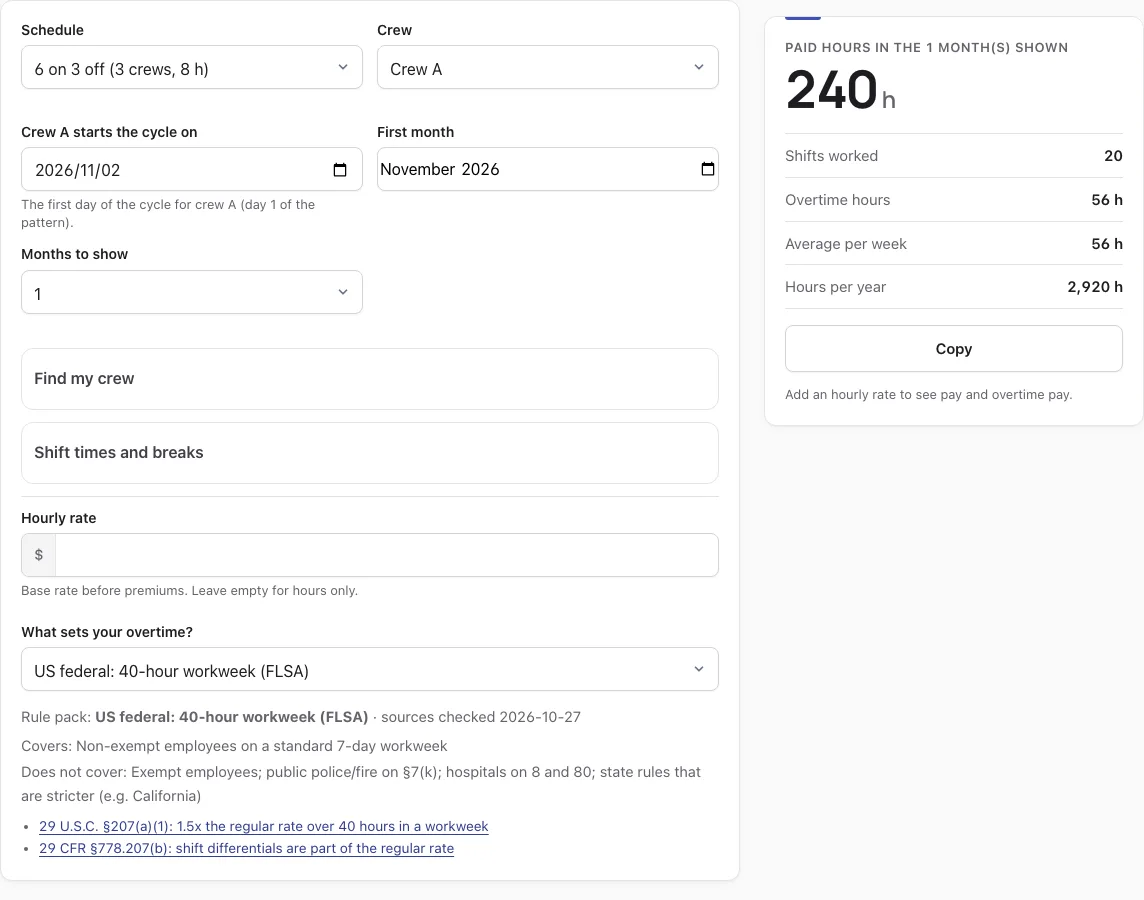
How to use the 6 on 3 off schedule
- Select your roster configuration: Choose the active rotation pattern, team platoon, or shift schedule that matches your workplace employment agreement or collective bargaining contract.
- Set cycle starting anchors: Enter your crew's start date in the anchor field to synchronize the calendar cycle with your actual calendar dates across upcoming operating months.
- Define shift times and meal breaks: Confirm the start time, end time, and unpaid meal period minutes. Standard shift defaults are provided but can be tailored to exact site facility hours.
- Input regular wage rates: Enter your baseline hourly pay rate to generate gross earnings, night shift premium differentials, and statutory weekly overtime projections.
- Choose the applicable legal rule pack: Select standard federal FLSA guidelines, California daily overtime rules, or public safety FLSA Section 7(k) exemptions according to your specific industry jurisdiction.
- Mark schedule exceptions on the calendar: Tap individual calendar dates to log paid time off, sick leave, shift trades, or overtime pickups without breaking the underlying baseline rotation structure.
- Export and save roster files: Download your schedule as an iCalendar (.ics) file to sync with mobile devices or export a comprehensive CSV spreadsheet for payroll verification and records.
Your personal modifications, shift swaps, and hourly rate selections remain securely stored in this browser session, allowing you to return and review updated figures throughout the entire work year without re-entering data.
How does a 6 on 3 off schedule work?
The 6 on 3 off schedule is a 9-day repeating shift pattern consisting of six consecutive working days followed by three consecutive days off duty. Because nine does not divide evenly into seven, the work block rotates continuously through the days of the week. Over a 9-week period (63 days), the cycle completes exactly seven full 9-day rotations, meaning an employee works on every day of the week and experiences every possible combination of mid-week and weekend rest.
Operational leaders and shift supervisors must continually balance continuous production goals with human physiological endurance. When teams maintain round-the-clock schedules, predictable shift sequences help operators plan family obligations, medical care, and personal commitments well in advance. Transparent scheduling reduces unscheduled absenteeism, turnover costs, and on-shift fatigue incidents across critical infrastructure operations.
6 On 3 Off 9-Day Rotation Progression Over 9 Weeks
| Cycle Week | Days Worked in 7-Day Week | Scheduled Hours (8h Shifts) | Rest Days | FLSA Overtime (>40h) |
|---|---|---|---|---|
| Week 1 | 5 days on | 40 hours | 2 days off | 0 overtime hours |
| Week 2 | 5 days on | 40 hours | 2 days off | 0 overtime hours |
| Week 3 | 4 days on | 32 hours | 3 days off | 0 overtime hours |
| Week 4 | 5 days on | 40 hours | 2 days off | 0 overtime hours |
| Week 5 | 5 days on | 40 hours | 2 days off | 0 overtime hours |
| 9-Week Cycle | 42 total days worked | 336 total hours | 21 days off | Average 37.33 hours/week |
Weekly hours, annual shifts, and fatigue management
Working 6 days out of every 9 means employees work exactly 66.67% of calendar days, averaging 243.3 work shifts per year. With standard 8-hour shifts, this produces 1,946.7 annual hours (an average of 37.33 paid hours per week). If shifts run 8.5 hours (8 hours paid plus 30-minute meal), gross hours total 2,068 per year. Because every single work block is followed by a full 72 hours (3 consecutive days) off duty, the schedule provides substantial physiological recovery between 6-day work stretches.
Understanding statutory shift thresholds prevents unexpected payroll discrepancies and ensures equitable rest distribution across all operational teams. When comparing rotations, always weigh the physiological benefits of extended recovery stretches against the cumulative fatigue incurred during intense multi-day work blocks. Proper roster design incorporates sufficient handover margins between shifts, transparent tracking of premium rate multipliers, and clear administrative procedures for voluntary overtime allocation.
How this tool works and where the numbers come from
The calculator maps rotation cycles day-by-day from your crew’s start date, tallying exact shift durations and meal breaks. Overtime is calculated across fixed workweeks or statutory 7(k) periods in accordance with federal FLSA regulations and state labor statutes. Results provide administrative estimates, not legal or payroll counsel.
Sources
- U.S. Office of Personnel Management: federal holidays (5 U.S.C. § 6103) (U.S. Code / CFR) · checked
- 29 U.S.C. § 207 (FLSA § 7): overtime after 40 hours a week; § 7(j) hospitals (8 and 80); § 7(k) fire and police work periods (U.S. Code, 2023 Edition) · checked
- 29 CFR Part 778: overtime compensation (regular rate, workweek) (eCFR current as of 2026-10-23) · checked
- 29 CFR § 778.105: the workweek is a fixed and regularly recurring period of 168 hours (eCFR current as of 2026-10-23) · checked
- 29 CFR § 778.207(b): shift differentials are part of the regular rate (eCFR current as of 2026-10-23) · checked
- U.S. Department of Labor, Fact Sheet #23: overtime pay requirements of the FLSA (Revised October 2019) · checked
- California Labor Code § 510: daily overtime over 8 hours, double time over 12, seventh day (as amended by Stats. 1999, ch. 134, effective 2000-01-01) · checked
- California Labor Code § 500: workday, workweek and alternative workweek schedule defined (added by Stats. 1999, ch. 134, effective 2000-01-01) · checked
- California DLSE: overtime FAQ (U.S. Code / CFR) · checked
Frequently asked questions
What is a 6 on 3 off schedule?
A 6 on 3 off schedule is a rotating work pattern where employees work six consecutive days followed by three consecutive days off. The 9-day cycle rotates across the calendar, so rest days advance forward every week in a predictable rhythm.
How many hours a week is a 6 on 3 off schedule?
With 8-hour shifts, employees average 37.33 paid hours per week over the 63-day master cycle. In any single calendar week, hours fluctuate between 32 and 48 hours depending on how the 3-day weekend falls within the employer’s payroll period.
How many days off do you get a year on 6 on 3 off?
Employees receive approximately 121.7 scheduled days off per year (one-third of all calendar days), delivered in consolidated blocks of three consecutive days off after every six working shifts for substantial recovery.
How many crews are needed to run a 6 on 3 off schedule?
To provide continuous daily coverage across seven days, a facility typically deploys three teams whose 9-day cycle start dates are staggered by three days each to avoid any unstaffed operational days.
Does a 6 on 3 off schedule provide full weekends off?
Yes. Because the 9-day cycle does not match a 7-day week, the three consecutive days off rotate continuously, providing full Friday-Saturday-Sunday weekends off every nine weeks.
Does the 6 on 3 off schedule count FLSA overtime?
Yes. The tool applies federal FLSA overtime, which counts hours over 40 in a week. With 8-hour shifts, the rotation table shows 40 hours in a 5-day week and 32 hours in a 4-day week, so 0 overtime hours. You can also choose California daily overtime rules or the public safety FLSA Section 7(k) rules.
Can I export a 6 on 3 off schedule?
Yes. You can download your schedule as an iCalendar (.ics) file to sync with mobile devices. You can also export a CSV spreadsheet for payroll verification and records. Your personal modifications, shift swaps and hourly rate selections stay stored in this browser session, so you can return and review them later.
Related tools
- Shift Calendar Maker: customize rotating rosters and build custom multi-crew schedules.
- DuPont Schedule Calendar: explore the classic 28-day 12-hour 4-crew rotation.
- Pitman Schedule Calendar: examine the popular 2-2-3 two-week alternating weekend system.
- 4 On 4 Off Schedule Calendar: evaluate continuous 8-day 12-hour work and rest cycles.
- Overtime Calculator for Shift Workers: compute statutory daily and weekly overtime under federal and state rules.
- Shift Differential Calculator: quantify night shift and weekend premium hourly supplements.
- Timesheet Calculator: tally weekly work hours, meal breaks, and gross pay.
- How Many Work Hours in a Year: translate weekly shift patterns into annual productive hours.