
7 On 7 Off Schedule Calendar
See the 7 on 7 off rotation for your crew by date, with the 84-hour work weeks and the overtime and pay they give.
Free · runs in your browser · nothing is uploaded
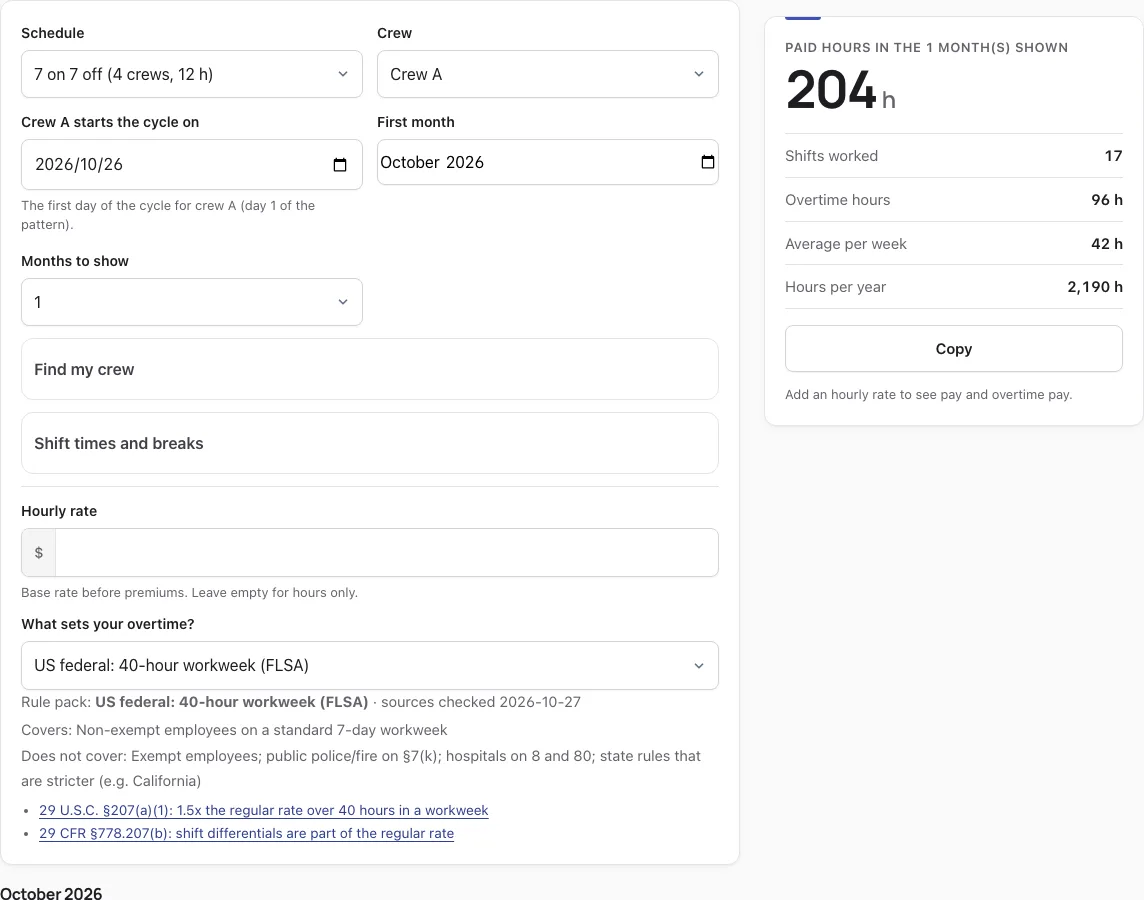
How to use the 7 On 7 Off Schedule Calendar
- Set Schedule to 7 on 7 off (days and nights).
- Enter the date in Crew A starts the cycle on. Crew A’s day 1 is set from this date, and the other crews follow on the same cycle, delayed by a fixed number of days.
- Use the Crew menu to switch between crews A, B, C and D. To find who works a shift, choose a shift and date, then tap Find my crew.
- Under Shift times and breaks, check the start, end and unpaid break of each shift type. The hours and pay update from these times.
- Enter your Hourly rate and pick a rule pack under What sets your overtime?
- Set First month and Months to show so the calendar covers the period you care about.
- Tap a day to record what really happened. On a work day, taps cycle through sick, vacation, off and swapped shift. On a day off, a tap marks a picked-up shift.
- Read the result card for paid hours, shifts worked, overtime hours and estimated gross pay.
- Use Download calendar (.ics) for one event per shift, Download CSV for a shift list, or Print for the calendar alone.
Your marks stay in this browser and do not change the rotation. Clear my marks removes them all at once.
How many hours a week does a 7 on 7 off schedule work?
A 7 on 7 off crew averages 42 paid hours a week across the cycle, but a single on-week with 12-hour shifts reaches 84 hours (seven shifts times 12 hours). A Monday-Sunday week can therefore range from 0 to 84 hours, depending on where the on-week falls.
| Measure | 7 on 7 off (days and nights) |
|---|---|
| Cycle length | 14 days |
| Work days per cycle | 7 |
| Longest run of work days | 7 |
| Longest run of days off | 7 |
| Average paid hours per week | 42 |
| Range in a Monday-Sunday week | 0 to 84 hours |
| Shifts per year | 182.5 |
| Paid hours per year | about 2,190 |
| Weekends fully off | 50% |
| 24/7 coverage with one crew | Yes, with default times every hour is covered by exactly one crew |
How much overtime does a 7 on 7 off schedule create?
The rule pack decides this, and the same schedule can produce very different results. In the tool’s worked example, Crew A starting 1 Nov 2026 is shown for four weeks to 28 Nov at $30 an hour: 14 shifts and 168 paid hours. Under the FLSA standard 40-hour workweek, 88 of those hours are overtime at 1.5x. Under the FLSA 7(k) fire rule (212 hours in a 28-day work period), there is no overtime.
| Rule pack | Overtime hours | Estimated gross pay |
|---|---|---|
| United States: FLSA standard workweek (40 h) | 88 at 1.5x | $6,360.00 |
| FLSA 7(k) fire (212 h in 28 days) | None | $5,040.00 |
The tool also offers California daily/weekly, the California health care 12-hour alternative workweek, 7(k) police, 7(j) 8 and 80. The Overtime Calculator adds a custom editor for contract rules. Each pack gives its own estimate for the same shifts. A week cut by the month edge still counts as a whole workweek for overtime. Every figure is an estimate, and contracts or union agreements can differ.
More questions
What is a 4/10 work schedule?
It means four 10-hour days a week, which adds up to 40 hours. The 4/10 Work Schedule Calendar shows it by date, and its California alternative workweek (10-hour) pack covers the overtime rules.
What is a compressed schedule?
It packs a full-time week into fewer, longer days; 4 x 10 hours and 9/80 are the usual forms. The 4/10 Work Schedule Calendar and 9/80 Work Schedule Calendar offer the California alternative workweek (10-hour) pack for them.
What is a 4-on-3-off shift pattern?
It is a rota of four consecutive work days followed by three days off, repeating every seven days. The Shift Calendar Maker builds it as a custom pattern written D4 O3.
Is 7 on 7 off better than 4-on-3-off?
It depends on your priorities. This tool shows that 7 on 7 off gives about 182 days off a year and fully off weekends half the time, while a 4-on-3-off rota gives 156 days off a year (three in every seven) with shorter runs of work.
How this tool works and where the numbers come from
The calendar repeats the rotation from your crew’s start date and counts every shift minute by minute. Overtime and pay are worked out over whole workweeks (or the 7(k) and 7(j) work periods) under the rule pack you pick, following the official texts below. Results are estimates, not legal or payroll advice.
Sources
- 29 U.S.C. § 207 (FLSA § 7): overtime after 40 hours a week; § 7(j) hospitals (8 and 80); § 7(k) fire and police work periods (U.S. Code, 2023 Edition) · checked
- 29 CFR Part 778: overtime compensation (regular rate, workweek) (eCFR current as of 2026-10-23) · checked
- 29 CFR § 778.105: the workweek is a fixed and regularly recurring period of 168 hours (eCFR current as of 2026-10-23) · checked
- 29 CFR § 778.207(b): shift differentials are part of the regular rate (eCFR current as of 2026-10-23) · checked
- California Labor Code § 510: daily overtime over 8 hours, double time over 12, seventh day (as amended by Stats. 1999, ch. 134, effective 2000-01-01) · checked
- California Labor Code § 500: workday, workweek and alternative workweek schedule defined (added by Stats. 1999, ch. 134, effective 2000-01-01) · checked
- IWC Wage Order 5 (public housekeeping incl. health care), section 3(B)(8): 12-hour health care alternative workweek (effective 2002-07-01 as amended; sections 4(A) and 10(C) republished effective 2019-01-01) · checked
- California Labor Code § 511: alternative workweek schedules (up to 10-hour days without overtime) (as amended by Stats. 2012, ch. 46 (SB 1038), effective 2012-06-27) · checked
- 29 CFR § 553.230: maximum hours table, 212 h fire / 171 h police per 28 days and shorter periods (eCFR current as of 2026-10-23) · checked
- 29 CFR § 553.224: the 7(k) work period (7 to 28 consecutive days) (eCFR current as of 2026-10-23) · checked
- 29 CFR § 553.222: sleep time, excludable only on tours of duty of more than 24 hours (eCFR current as of 2026-10-23) · checked
- 29 U.S.C. § 213(b)(20) (FLSA § 13(b)(20)): fire and police agencies with fewer than 5 such employees (U.S. Code, 2023 Edition) · checked
- 29 CFR § 778.601: hospitals and residential care, 14-day period (8 and 80) (eCFR current as of 2026-10-23) · checked
- U.S. Office of Personnel Management: federal holidays (5 U.S.C. § 6103) · checked
- U.S. Department of Labor, Fact Sheet #23: overtime pay requirements of the FLSA (Revised October 2019) · checked
- California DLSE: overtime FAQ · checked
- California DLSE: overtime exceptions FAQ (alternative workweeks) · checked
- U.S. Department of Labor, Fact Sheet #8: law enforcement and fire protection employees (Revised March 2011) · checked
- U.S. Department of Labor, Fact Sheet #54: health care industry and overtime (8 and 80) (Revised July 2009) · checked
Frequently asked questions
Is a 7 on 7 off schedule good?
It depends on what you value most. Each crew gets a full week off after a full week on, and weekends are fully off half the time. On the other hand, a single on-week of 12-hour shifts can reach 84 hours.
What is a 7 on 7 off schedule?
It is a rota where you work seven days in a row, then have seven days off, and the cycle repeats every 14 days. In this tool, all four crews follow this cycle, each one offset from the others so the site stays covered.
How long are 7 on 7 off shifts?
The default day and night shifts are 12 hours each, 07:00 to 19:00 and 19:00 to 07:00. Under Shift times and breaks you can change any shift, and the tool also supports 24-hour shifts (07:00-07:00) and 8-hour codes.
What industries use 7 on 7 off schedules?
Round-the-clock work such as hospitals, factories, security and emergency services often uses rotas like this, because someone has to cover every hour. This is general knowledge, and the tool does not check your industry.
Is 7 on 7 off hard on family life?
It groups the disruption into blocks: one full week away, then one full week at home, rather than a shifting weekly pattern. Whether that helps depends on your household, so talk it through with the people involved. Print gives you a clean copy of the calendar to share.
How many teams does 7 on 7 off need?
Four crews. The tool runs crews A to D on a 14-day cycle, and each crew works 7 of the 14 days. Under the default times, every hour is covered by exactly one crew.
How many days off do you get with 7 on 7 off?
About 182 days a year. Each crew works 182.5 shifts a year, so the other half of the year is off.
Is a 7 on 7 off pattern legal in the UK?
This tool only uses US rule packs, so it does not check UK rules. The Working Time Regulations 1998 limit a night worker to 8 hours per 24 on average over the reference period and give night workers a right to a free health assessment. Your contract applies, so check with your employer.
Related tools
- Shift Calendar Maker: use this for a general shift rota when your pattern is not a 7 on 7 off cycle.
- DuPont Schedule Calendar: check this if you want a different rotating pattern with more frequent days off.
- Pitman Schedule Calendar: use this to compare a two-week rotation with a different set of work and rest days.
- 4 On 4 Off Schedule Calendar: choose this for a pattern of equal four-day blocks on and off.
- 12 Hour Shift Schedule Comparison: read this when you are weighing 12-hour shift patterns against each other.
- Overtime Calculator for Shift Workers: use this to check overtime on hours you enter yourself.
- Timesheet Calculator: use this to total the hours for a single day or week from start and end times.
- How Many Work Hours in a Year: read this to see how a year of shifts adds up in hours.