
Circadian Shift Adjustment Calculator
The circadian shift adjustment calculator maps rotating shift cycles and estimates sleep transition windows between day and night shifts. It builds a day-by-day calendar from your crew's start date, and all roster calculations run entirely within your local browser. Results are administrative estimates, not legal or payroll counsel.
Free · runs in your browser · nothing is uploaded
The Circadian Shift Adjustment Calculator provides an interactive calculation engine and calendar for rotating shift workers, team supervisors, and payroll managers. By analyzing scheduled shift hours, rest intervals, and overtime pay rules, this circadian shift adjustment calculator clarifies complex working patterns before duty begins. Whether planning crew coverage across a 28-day cycle or checking take-home compensation under federal and state wage statutes, the tool computes daily hours, weekly totals, and statutory overtime minute by minute. All roster calculations run entirely within your local browser, keeping your personal work history and wage inputs confidential. You can export completed rosters directly as an iCalendar (.ics) feed or download detailed spreadsheet data for administrative recordkeeping.
Enter your crew’s start date and shift times in the calculator to map your rotation day by day.
At a glance
The circadian shift adjustment calculator plans rotating shift schedules using circadian phase delay and advance rates, sleep windows, and transition days between day and night shifts. Its results are administrative estimates, not legal or payroll counsel.
- The human internal circadian clock runs on an intrinsic period of approximately 24.2 hours.
- A person can naturally adjust their internal clock forward by 1.5 to 2 hours per 24-hour day, whereas advancing sleep earlier occurs at a rate of only 0.5 to 1.0 hour per day.
- A static night shift requires 10 to 14 days for a complete circadian inversion.
- The calculator maps rotation cycles day-by-day from your crew's start date, tallying exact shift durations and meal breaks.
- Overtime is calculated across fixed workweeks or statutory 7(k) periods in accordance with federal FLSA regulations and state labor statutes, and results provide administrative estimates, not legal or payroll counsel.
- All roster calculations run entirely within your local browser, keeping your personal work history and wage inputs confidential.
How to use the circadian shift adjustment calculator
- Select your roster configuration: Choose the active rotation pattern, team platoon, or shift schedule that matches your workplace employment agreement or collective bargaining contract.
- Set cycle starting anchors: Enter your crew's start date in the anchor field to synchronize the calendar cycle with your actual calendar dates across upcoming operating months.
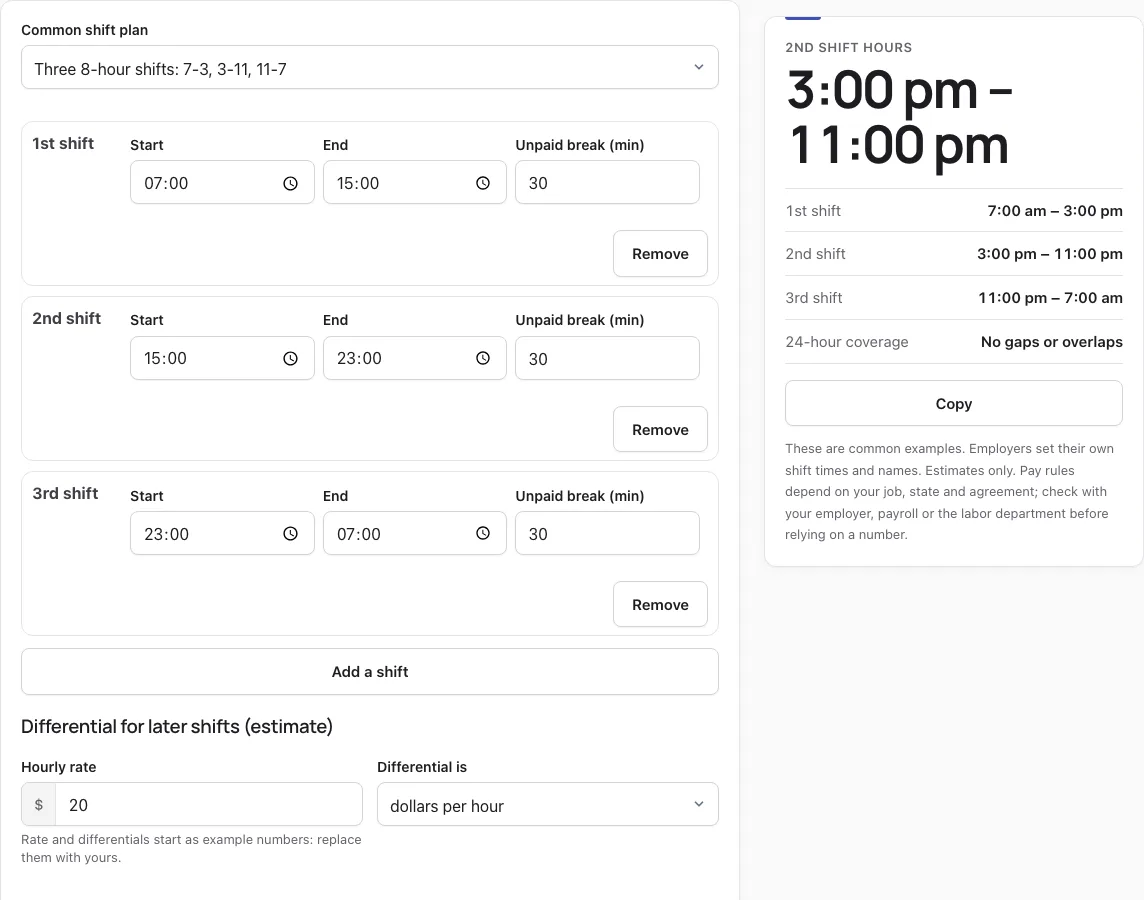
- Define shift times and meal breaks: Confirm the start time, end time, and unpaid meal period minutes. Standard shift defaults are provided but can be tailored to exact site facility hours.
- Input regular wage rates: Enter your baseline hourly pay rate to generate gross earnings, night shift premium differentials, and statutory weekly overtime projections.
- Choose the applicable legal rule pack: Select standard federal FLSA guidelines, California daily overtime rules, or public safety FLSA Section 7(k) exemptions according to your specific industry jurisdiction.
- Mark schedule exceptions on the calendar: Tap individual calendar dates to log paid time off, sick leave, shift trades, or overtime pickups without breaking the underlying baseline rotation structure.
- Export and save roster files: Download your schedule as an iCalendar (.ics) file to sync with mobile devices or export a comprehensive CSV spreadsheet for payroll verification and records.
Your personal modifications, shift swaps, and hourly rate selections remain securely stored in this browser session, allowing you to return and review updated figures throughout the entire work year without re-entering data.
How does circadian rhythm adjustment work?
The human internal circadian clock naturally runs on an intrinsic period slightly longer than 24 hours (approximately 24.2 hours). As a consequence of this biological predisposition, delaying sleep times (going to bed later, or phase delay) is substantially easier for the human body to achieve than advancing sleep times (going to bed earlier, or phase advance). A person can naturally adjust their internal clock forward by 1.5 to 2 hours per 24-hour day, whereas advancing sleep earlier occurs at a sluggish rate of only 0.5 to 1.0 hour per day.
Operational leaders and shift supervisors must continually balance continuous production goals with human physiological endurance. When teams maintain round-the-clock schedules, predictable shift sequences help operators plan family obligations, medical care, and personal commitments well in advance. Transparent scheduling reduces unscheduled absenteeism, turnover costs, and on-shift fatigue incidents across critical infrastructure operations.
Circadian Phase Shift Adaptation Dynamics by Rotation Direction
| Rotation Direction | Phase Movement | Biological Adjustment Rate | Adaptation Difficulty | Recommended Protocol |
|---|---|---|---|---|
| Forward Rotation (Clockwise) | Phase Delay (Later) | 1.5 to 2.0 hours per day | Lower biological resistance | Day -> Evening -> Night shift |
| Backward Rotation (Counter-CW) | Phase Advance (Earlier) | 0.5 to 1.0 hour per day | High circadian friction | Night -> Evening -> Day shift |
| Static Night Shift | Complete Inversion | Requires 10 to 14 days | Challenging social conflict | Maintain night sleep on off-days |
| Rapid Fast Rotation | Zero Phase Shift Goal | Maintains diurnal baseline | Preserves normal circadian cycle | Limit nights to 2 consecutive shifts |
Strategic light exposure and transition day protocols
Light is the primary zeitgeber (time giver) that resets the mammalian master clock. To adjust into a night shift stretch, workers should seek bright light exposure during the first half of their nocturnal shift (22:00 to 02:00) to suppress melatonin and push their clock later. Conversely, during the post-shift commute home, wearing dark polarized sunglasses prevents morning sunlight from triggering premature circadian daytime wakefulness, enabling 6 to 7 hours of daytime consolidated sleep.
Understanding statutory shift thresholds prevents unexpected payroll discrepancies and ensures equitable rest distribution across all operational teams. When comparing rotations, always weigh the physiological benefits of extended recovery stretches against the cumulative fatigue incurred during intense multi-day work blocks. Proper roster design incorporates sufficient handover margins between shifts, transparent tracking of premium rate multipliers, and clear administrative procedures for voluntary overtime allocation.
How this tool works and where the numbers come from
The calculator maps rotation cycles day-by-day from your crew’s start date, tallying exact shift durations and meal breaks. Overtime is calculated across fixed workweeks or statutory 7(k) periods in accordance with federal FLSA regulations and state labor statutes. Results provide administrative estimates, not legal or payroll counsel.
Sources
- 29 CFR Part 785: hours worked (all time the employee is required or allowed to work) (eCFR current as of 2026-10-23) · checked
- 29 U.S.C. § 207 (FLSA § 7): overtime after 40 hours a week; § 7(j) hospitals (8 and 80); § 7(k) fire and police work periods (U.S. Code, 2023 Edition) · checked
Frequently asked questions
Why is forward shift rotation better than backward rotation?
Forward rotation (Day to Evening to Night) aligns with the human circadian clock’s natural tendency to delay sleep by 1.5 to 2 hours per day. Backward rotation forces phase advancement, causing severe sleep onset insomnia and acute fatigue.
How long does it take for your circadian rhythm to flip for night shift?
It takes approximately 10 to 14 days of consistent nocturnal scheduling for peripheral organs and melatonin secretion to fully invert. On rotating rosters, full adaptation is rarely achieved, which is why rapid rotations aim to prevent circadian shifting altogether.
What is the anchor sleep strategy for shift workers?
Anchor sleep involves keeping a constant 4-hour sleep window (such as 08:00 to 12:00) on both work days and days off, supplemented by a secondary nap, preventing total circadian desynchronization across the workweek.
How should light exposure be timed when working nights?
Maximize bright light exposure (10,000 lux or blue-enriched LED) between 22:00 and 02:00 to enhance vigilance. Avoid bright light after 04:00, and wear dark wraparound sunglasses during the morning drive home to protect daytime sleep quality.
What role does melatonin supplementation play in shift work?
Taking 0.5mg to 3mg of melatonin 30 to 60 minutes prior to planned daytime sleep helps simulate the nocturnal biological hormone surge, facilitating earlier sleep onset on night shift rotations.
Does the calculator store my roster and wage inputs?
All roster calculations run entirely within your local browser, which keeps your personal work history and wage inputs confidential. Your shift swaps and hourly rate selections remain stored in this browser session. You can return later and review updated figures without re-entering data.
What can I export from the calculator?
You can download your schedule as an iCalendar (.ics) file to sync with mobile devices. You can also export a comprehensive CSV spreadsheet for payroll verification and records. The spreadsheet data is meant for administrative recordkeeping. Results are administrative estimates, not legal or payroll counsel.
Related tools
- Shift Calendar Maker: customize rotating rosters and build custom multi-crew schedules.
- DuPont Schedule Calendar: explore the classic 28-day 12-hour 4-crew rotation.
- Pitman Schedule Calendar: examine the popular 2-2-3 two-week alternating weekend system.
- 4 On 4 Off Schedule Calendar: evaluate continuous 8-day 12-hour work and rest cycles.
- Overtime Calculator for Shift Workers: compute statutory daily and weekly overtime under federal and state rules.
- Shift Differential Calculator: quantify night shift and weekend premium hourly supplements.
- Timesheet Calculator: tally weekly work hours, meal breaks, and gross pay.
- How Many Work Hours in a Year: translate weekly shift patterns into annual productive hours.