
Holiday Pay Calculator
Enter your rate, the holiday multiplier and the hours worked to see holiday pay, and check which holidays land on your scheduled days.
Free · runs in your browser · nothing is uploaded
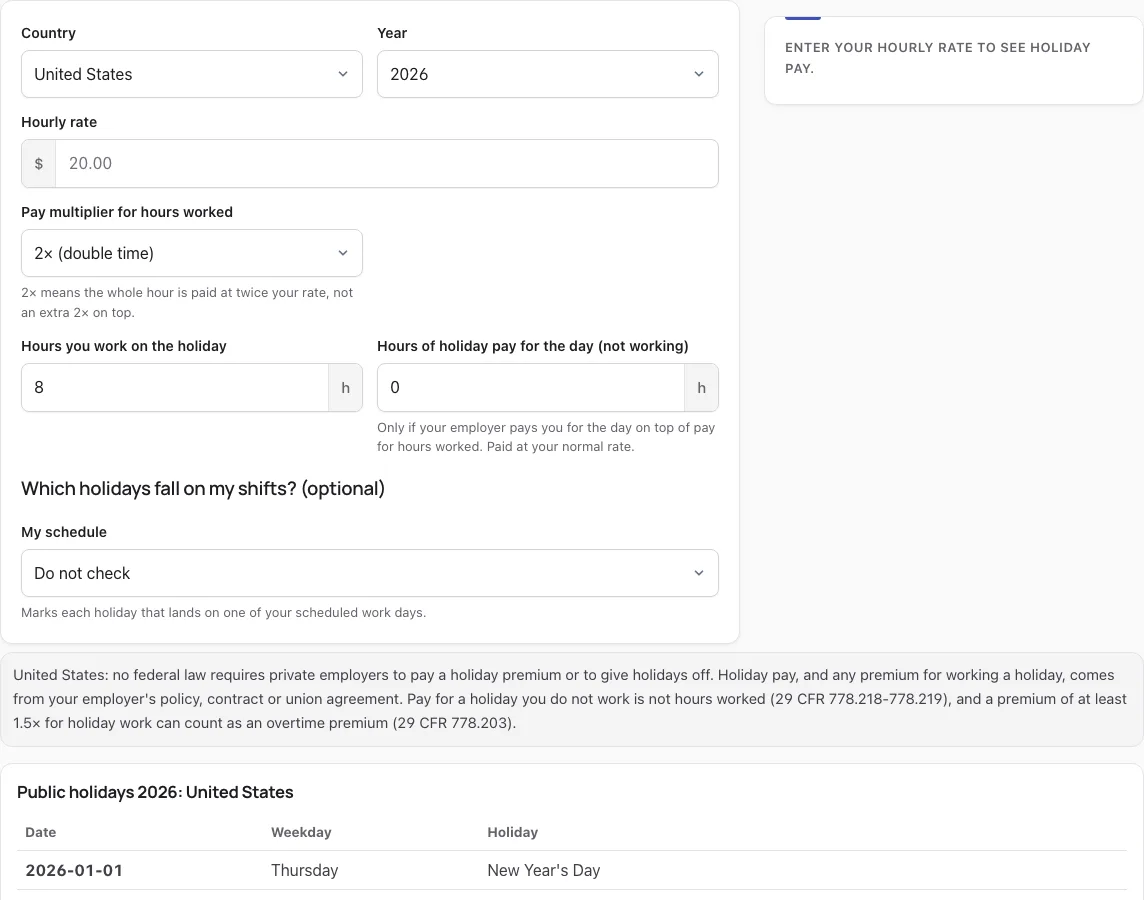
How to use the Holiday Pay Calculator
- Choose your Country (United States, United Kingdom, Canada or Australia) and a Year from 2025 to 2030.
- Type your Hourly rate.
- Under Pay multiplier for hours worked, pick 1.5× (time and a half), 2× (double time) or 2.5×. For any other rate, choose Other multiplier and type it in Your multiplier.
- Set Hours you work on the holiday. The default is 8.
- If your employer also pays for the day you are not working, enter the hours in Hours of holiday pay for the day (not working). The default is 0.
- Read the result card. It shows Pay for 8 h worked at 2×, Same hours at your normal rate, the extra for working the holiday, any holiday pay for the day, and the Total for the day.
- Optional: under Which holidays fall on my shifts?, choose My schedule. Pick Monday to Friday or a rotation such as DuPont, Pitman, 4 on 4 off or 24 on 48 off, then set Crew and Crew A starts the cycle on.
- Check the On my schedule? column. It shows Yes or No for each holiday, and a line estimates the extra and total if you work every scheduled holiday.
Your settings are kept in the page address, so a bookmarked or shared link reopens with the same inputs. Overtime on the rest of the week is not added here. Use the overtime calculator for that.
How is holiday pay calculated?
The tool multiplies hours worked by your hourly rate and the multiplier to get pay for the hours worked. It then subtracts your normal rate for the same hours to find the extra, and adds any holiday pay for a day not worked. The multiplier is the pay for the whole hour, not an extra on top.
- Hours worked × hourly rate × multiplier = pay for hours worked.
- Hours worked × hourly rate = same hours at your normal rate.
- Pay for hours worked − same hours at normal rate = extra for working the holiday.
- Hours of holiday pay for the day × hourly rate = holiday pay for the day not worked.
- Pay for hours worked + holiday pay for the day = total for the day.
| Example | Inputs | Pay for hours worked | Extra over normal | Total for the day |
|---|---|---|---|---|
| Double time, 8 hours | $20/h, 2×, 8 h worked, 0 h holiday pay | $320.00 | $160.00 | $320.00 |
| Double time plus holiday pay | $20/h, 2×, 8 h worked, 8 h holiday pay | $320.00 | $160.00 | $480.00 |
| Time and a half, 7.5 hours | $18.50/h, 1.5×, 7.5 h worked | $208.125 (shown rounded) | $69.375 (shown rounded) | $208.125 (shown rounded) |
Entering a multiplier below 1 is treated as 1 in the calculation. Without an hourly rate, the page shows “Enter your hourly rate to see holiday pay.” and still lists the holidays.
What is holiday pay for $20 an hour?
Eight hours on the holiday at $20 and double time come to $320 for the hours worked. Of that, $160 is the extra over a normal 8-hour day. If your employer also pays 8 hours for a day you do not work, add $160 for a total of $480.
Other combinations work the same way. For a holiday you do not work at $16 an hour with 8 hours paid, the holiday pay is $128 (8 × $16). To check that case, set Hours you work on the holiday to 0 and Hours of holiday pay for the day to 8.
More questions
How much is holiday pay?
In the US, employers that pay a premium typically use 1.5× (time and a half) or 2× (double time) for hours worked on a holiday. At $20 an hour, 8 hours at 2× gives $320 for the day.
Why do you need a holiday pay calculator?
Where work never stops, shift crews end up on public holidays every year, and the rotation decides which ones. A calculator shows how a holiday shift compares with a normal day, and whether your rotation puts you on a holiday.
Are holiday rules the same in every country?
No. Each Canadian province and territory sets its own rules, and Australia uses state, territory and award rules. The UK depends on contracts, and bank-holiday dates differ between England and Wales, Scotland and Northern Ireland.
Which holidays does the table list?
The table lists national public holidays only, with date, weekday and name. It has 12 entries for the US in 2026, 9 for the UK, 5 for Canada and 7 for Australia. Regional holidays are not included.
How this tool works and where the numbers come from
Holiday pay is the hours times your rate times the multiplier you enter; the tool does not set a legal rate. Holiday dates come from the official national lists below (via the python-holidays dataset), checked for 2026 and 2027.
Sources
- U.S. Office of Personnel Management: federal holidays (5 U.S.C. § 6103) · checked
- 29 CFR § 778.218: pay for holidays and other days when no work is performed (eCFR current as of 2026-10-23) · checked
- 29 CFR § 778.219: pay for foregoing holidays and vacations (eCFR current as of 2026-10-23) · checked
- 29 CFR § 778.203: premium pay for work on Saturdays, Sundays and holidays (eCFR current as of 2026-10-23) · checked
- GOV.UK: UK bank holidays (England and Wales, Scotland, Northern Ireland) (page last updated 2025-11-24) · checked
- GOV.UK: holiday entitlement and bank holidays (no statutory right to time off or extra pay) · checked
- Canada Labour Code, s. 166: general holidays (federally regulated employers) (current to 2026-09-30, last amended 2025-12-12) · checked
- Canada Labour Code, s. 196: holiday pay (current to 2026-09-30, last amended 2025-12-12) · checked
- Fair Work Ombudsman (Australia): public holidays by state and territory · checked
Frequently asked questions
What is holiday pay?
Holiday pay is what an employer pays for a public holiday, whether you work that day, take it off, or do both. Whether you receive it depends on your employer’s policy, contract or union agreement, not on one national rule.
Do part-time employees get holiday pay?
Not always. Some employers pay it only to full-time staff; your contract or handbook says which applies. The calculator works from the hours and rate you enter, so use the figures that apply to your role.
Does holiday pay count toward overtime?
Hours paid for a holiday you did not work are not hours worked under the FLSA, so they do not push the week past 40. The CFR sections 29 CFR 778.218 and 778.219 cover pay for a holiday not worked. This page does not add overtime, so use the overtime calculator for the full week.
How is holiday pay taxed?
It is taxed as ordinary wages, with the usual income tax and payroll withholding. Your payslip shows the actual deductions, which depend on your own situation.
How does holiday pay work?
A common policy pays 1.5x or 2x for hours worked on the employer’s listed holidays. Holiday pay for a day you do not work is a separate amount, and the calculator shows it on its own line.
Is holiday pay required by law?
Not in the US private sector: federal law leaves paid holidays and holiday premiums to employer policy or contract. In the UK there is no statutory right to extra pay or time off on a bank holiday, so it depends on your contract.
What is time and a half pay?
Time and a half is 1.5 times your regular hourly wage, which is 50% more per hour. Choose 1.5× (time and a half) in the calculator. For 7.5 hours at $18.50, the pay for hours worked is $208.125, shown as $208.13.
What is the holiday pay rate?
The holiday pay rate is your normal hourly rate, and the multiplier applies only to hours worked. Some employers pay 8 hours at your normal rate for a holiday not worked, which you enter as Hours of holiday pay for the day (not working).
Related tools
- Overtime calculator: use it to check overtime for the whole workweek, since holiday hours are not added here.
- Shift differential calculator: use it when a shift premium is paid on top of your base rate.
- How many work hours in a year: use it to see annual hours with public holidays subtracted.
- Timesheet calculator: use it to total the hours you log on each shift.
- DuPont schedule calendar and pay: use it if your rotation follows the DuPont pattern.
- Pitman schedule calendar and pay: use it if your rotation follows the Pitman pattern.
- 24 on 48 off schedule: use it to look at a 24 on 48 off rotation in detail.
- Shift calendar: use it to view your shifts across the year.