
Kelly Schedule Calendar
Pick your platoon to see the 9-day Kelly rotation by date and the hours, overtime and pay in each work period.
Free · runs in your browser · nothing is uploaded
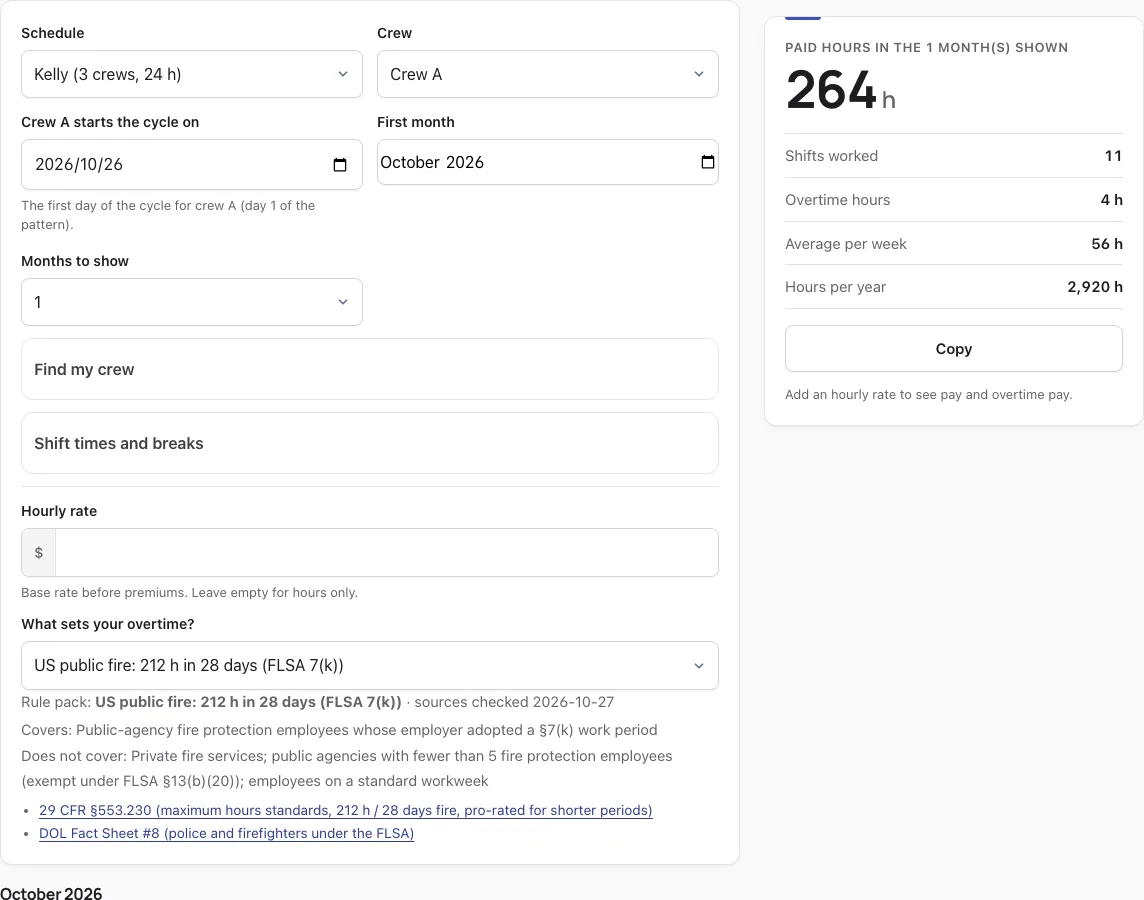
How to use the Kelly schedule calendar
- Open Schedule and choose the Kelly pattern (24 on, 24 off, 24 on, 24 off, 24 on, 96 off).
- Set Crew A starts the cycle on to the first day of crew A’s rotation. The other crews follow the same cycle, delayed by a fixed number of days.
- Use the Crew menu to switch between crews, or enter a shift and date under Find my crew to find who works that shift on that day.
- Under Shift times and breaks, check the start, end and unpaid break for each shift type. The default 24-hour shift runs 07:00 to 07:00 with no unpaid break.
- Enter your Hourly rate and pick a rule pack under What sets your overtime?
- Set First month and Months to show so the result card covers the period you care about.
- Tap a day to record what really happened. On a work day, taps cycle through sick, vacation, off and swapped shift. On a day off, a tap marks a picked-up shift. These marks do not move the rotation, and they stay in this browser. Clear my marks removes them.
When the calendar looks right, use Download calendar (.ics) for one event per worked shift, Download CSV for shift-by-shift paid, regular and overtime hours, or Print to print the calendar without the form.
What is a Kelly shift schedule?
A Kelly shift schedule is a rotating pattern of 24-hour shifts: 24 hours on, 24 off, 24 on, 24 off, 24 on, then 96 off. The full cycle is 9 days, and with three crews one crew is on duty at every hour. The figures below come from the tool’s calculation for crew A.
| Measure | Kelly pattern, crew A |
|---|---|
| Cycle length | 9 days |
| Work days per cycle | 3 of 9 |
| Longest run on / off | 1 day on, 4 days off |
| Average paid hours per week | 56 |
| Range in a Monday to Sunday week | 48 to 72 hours |
| Shifts and paid hours per year | about 121.7 shifts, about 2920 hours |
| Weekends fully off | 33% |
| 24/7 coverage with one crew | Yes, every hour covered by exactly one crew |
How does the tool estimate overtime for a Kelly crew?
The tool counts overtime using the rule pack you choose, over whole workweeks around the months shown. Under the FLSA 7(k) fire pack, overtime applies after 212 hours in a 28-day period. In the worked example, crew A starting 1 Nov 2026, over four weeks to 28 Nov at $30 an hour, gives 10 shifts and 240 paid hours. That is 219 regular hours at $30 ($6,570.00) plus 21 overtime hours at 1.5x ($945.00), for an estimated gross of $7,515.00.
| Rule pack | What it measures |
|---|---|
| US federal 40-hour workweek (FLSA) | 40 hours in a workweek |
| California daily, weekly and 7th-day | Daily, weekly and seventh-day rules |
| California health care alternative workweek | 12-hour alternative workweek |
| California alternative workweek | 10-hour alternative workweek |
| FLSA 7(k) fire | 212 hours in 28 days |
| FLSA 7(k) police | 171 hours in 28 days |
| FLSA 7(j) 8 and 80 | 8 hours in a day and 80 hours in 14 days |
Running the same four weeks under a different pack changes the result card, so you can compare regimes before you rely on any figure. In that window crew A works on 1, 3, 5, 10, 12, 14, 19, 21, 23 and 28 November; the shift that starts on 28 November ends at 07:00 on 29 November, so its last 7 hours count in the next 28-day work period, which is why the regular hours stop at 219 rather than 212 plus the full overtime.
How this tool works and where the numbers come from
The calendar repeats the rotation from your crew’s start date and counts every shift minute by minute. Overtime and pay are worked out over whole workweeks (or the 7(k) and 7(j) work periods) under the rule pack you pick, following the official texts below. Results are estimates, not legal or payroll advice.
Sources
- 29 U.S.C. § 207 (FLSA § 7): overtime after 40 hours a week; § 7(j) hospitals (8 and 80); § 7(k) fire and police work periods (U.S. Code, 2023 Edition) · checked
- 29 CFR § 553.230: maximum hours table, 212 h fire / 171 h police per 28 days and shorter periods (eCFR current as of 2026-10-23) · checked
- 29 CFR § 553.224: the 7(k) work period (7 to 28 consecutive days) (eCFR current as of 2026-10-23) · checked
- 29 CFR § 553.222: sleep time, excludable only on tours of duty of more than 24 hours (eCFR current as of 2026-10-23) · checked
- 29 U.S.C. § 213(b)(20) (FLSA § 13(b)(20)): fire and police agencies with fewer than 5 such employees (U.S. Code, 2023 Edition) · checked
- 29 CFR Part 778: overtime compensation (regular rate, workweek) (eCFR current as of 2026-10-23) · checked
- 29 CFR § 778.105: the workweek is a fixed and regularly recurring period of 168 hours (eCFR current as of 2026-10-23) · checked
- 29 CFR § 778.207(b): shift differentials are part of the regular rate (eCFR current as of 2026-10-23) · checked
- California Labor Code § 510: daily overtime over 8 hours, double time over 12, seventh day (as amended by Stats. 1999, ch. 134, effective 2000-01-01) · checked
- California Labor Code § 500: workday, workweek and alternative workweek schedule defined (added by Stats. 1999, ch. 134, effective 2000-01-01) · checked
- U.S. Office of Personnel Management: federal holidays (5 U.S.C. § 6103) · checked
- U.S. Department of Labor, Fact Sheet #8: law enforcement and fire protection employees (Revised March 2011) · checked
- U.S. Department of Labor, Fact Sheet #23: overtime pay requirements of the FLSA (Revised October 2019) · checked
- California DLSE: overtime FAQ · checked
Frequently asked questions
What is a Kelly week?
“Kelly week” is used loosely for the part of the 9-day cycle that falls within a given week. Because 9 days does not divide evenly into 7-day weeks, each calendar week in the tool shows a different mix of work and off days.
Do you get paid for Kelly days?
The estimate counts paid hours only for shifts a crew works, so a scheduled day off adds no paid hours. Whether an employer pays for a day off depends on the employer, contract or union agreement, which the tool cannot see. A picked-up shift counts as a normal shift toward the weekly or period threshold, except under the California 10-hour alternative workweek pack, where a day outside the adopted schedule pays the first 8 hours at 1.5x and hours over 8 at 2x. For a contract or union rule, use the Overtime Calculator, which has a custom rule editor.
Why do firefighters have Kelly days?
The tool does not cover the history of the schedule. What it shows is that 24-hour shifts followed by long rests let one crew cover every hour, averaging about 56 paid hours per week for crew A. The 7(k) fire pack reflects a longer work period of 212 hours in 28 days before overtime applies.
Is the pay estimate legal or payroll advice?
No. Every pay result is an estimate under the rule pack you pick. Contracts and union or collective agreements can differ, so check your own agreement with your employer.
Related tools
- Shift Calendar Maker: build a shift calendar for any rotation you set up yourself.
- DuPont Schedule Calendar: compare a DuPont rotation with the Kelly pattern.
- Pitman Schedule Calendar: see how a Pitman rotation covers the same weeks.
- 4 On 4 Off Schedule Calendar: plan a simple two-crew rotation with equal days on and off.
- 12 Hour Shift Schedule Comparison: weigh 12-hour patterns against each other.
- Overtime Calculator for Shift Workers: check overtime figures outside the calendar.
- Timesheet Calculator: add up hours from start and end times for a single week.
- How Many Work Hours in a Year: see how annual hours compare with a rotation’s yearly total.