
Overtime Calculator for Shift Workers
Enter the shifts you worked, pick the overtime rule that applies to you and see regular hours, overtime at each rate and gross pay.
Free · runs in your browser · nothing is uploaded
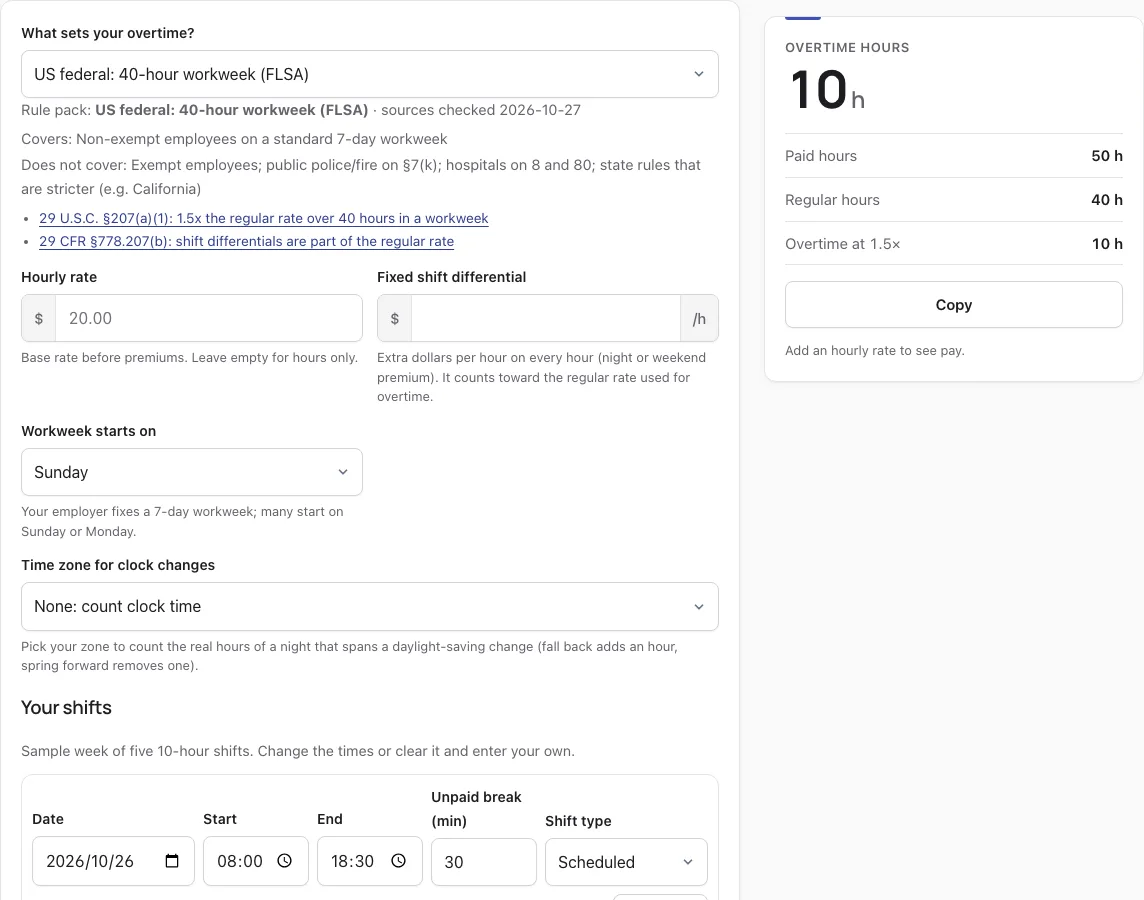
How to use the overtime calculator
- Open “What sets your overtime?” and choose the rule pack that matches your schedule. Read its “who it covers” and “who it does not cover” lines.
- Enter your Hourly rate. Leave it empty if you only want hours.
- Enter a Fixed shift differential in dollars per hour if you receive one.
- Check Workweek starts on. Every US pack defaults to Sunday.
- For a fire or police pack, set Work period starts on and, for fire, Work period length (days).
- In Your shifts, fill in Date, Start, End and Unpaid break (min) for each row, and pick a Shift type.
- Use Add shift, Copy last shift to next day or Fill a week (Mon-Fri) to build the list faster. Clear all starts over.
- Read the result card: Paid hours, Regular hours, one row per multiplier, Regular rate and Estimated gross pay. Then check Week by week and Shift by shift below the tool.
The page address stores your entries, so copying the link reopens the same calculation. Download CSV saves your shift rows with their pay figures, and Print or save as PDF opens your browser’s print dialog. Each rule pack shows the regulation or statute it comes from as a link under the menu.
How is overtime pay calculated?
Overtime pay uses the regular-rate method. Every paid hour earns your base rate plus any differential, and each overtime hour adds the extra part of its multiplier on top. At 1.5x, that extra is half the regular rate. Under the federal rule, hours over 40 in a workweek are the overtime hours.
- Total the paid hours in the workweek. Time is counted to the minute, and the unpaid break is taken from the middle of each shift.
- Set regular hours to 40 under the federal rule, and treat any hours above that as overtime.
- Find the regular rate: hourly rate plus fixed shift differential.
- For each overtime hour, add (multiplier - 1) times the regular rate. At 1.5x, that is 0.5 times the rate.
- Estimated gross pay is paid hours times the regular rate, plus the overtime part.
Worked example: FLSA pack, $20 an hour, five shifts from 09:00 to 19:30 with a 30-minute break (10 paid hours each).
| Item | Result |
|---|---|
| Paid hours | 50 |
| Regular hours | 40 |
| Overtime at 1.5x | 10 |
| Regular rate | $20.00 |
| Overtime part of pay | $100.00 |
| Estimated gross pay | $1,100.00 |
Adding a $2 differential raises the regular rate to $22.00 and the overtime part to $110.00, for an estimated $1,210.00.
How do I calculate hourly rate?
To get an hourly rate from a yearly figure, first multiply your hours per week by 52 to get your hours per year. Then divide your yearly pay by that total. The result is the number to type into the Hourly rate field.
- Multiply hours per week by 52. For example, 40 hours a week gives 2,080 hours a year.
- Divide yearly pay by that total. A yearly pay of $41,600 divided by 2,080 gives $20.00 an hour.
- Enter that figure in Hourly rate.
How does the 7(k) work period limit work?
Under the FLSA 7(k) fire and police packs, overtime is decided over a work period, not a single week. The fire limit is 212 hours in 28 days, and the police limit is 171 hours. Shorter periods get a pro-rated limit, and hours above it are paid at 1.5x.
| Work period length (fire pack) | Limit before overtime |
|---|---|
| 28 days | 212 hours |
| 14 days | 106 hours |
| 7 days | 53 hours |
Worked example: 22 ten-hour shifts from 07:00 to 17:00 starting 2026-11-01, at $10 an hour, in the fire pack. That is 220 hours against a 212-hour limit, so 8 hours get 1.5x, for an estimated $2,240.00 (220 × $10 + 8 × $5). The weekly table still shows overtime per calendar workweek, but the Work periods table decides the overtime.
Which rule pack should I choose?
Choose the pack that matches the rule your employer or agreement follows. The US federal pack covers a 40-hour week. California packs add daily limits, fire, police and hospital packs use work periods, and the custom pack takes your own contract terms.
| Rule pack | Overtime thresholds |
|---|---|
| US federal: 40-hour workweek (FLSA) | Over 40 h in a workweek, 1.5x |
| California: daily, weekly and 7th-day overtime | Over 8 h a day 1.5x, over 12 h 2x, over 40 h a week 1.5x |
| California alternative workweek (10-hour days) | Over 10 h a day 1.5x, over 12 h 2x, over 40 h a week 1.5x |
| California health care alternative workweek (12-hour shifts) | Over 12 h a day 2x, over 40 h a week 1.5x |
| US public fire: 212 h in 28 days (FLSA 7(k)) | Over 212 h in the work period, 1.5x |
| US public police: 171 h in 28 days (FLSA 7(k)) | Over 171 h in the work period, 1.5x |
| US hospitals: 8 and 80 (FLSA 7(j)) | Over 8 h a day or 80 h in 14 days, whichever is greater |
| My contract or union agreement (custom) | Your own daily and weekly steps, pickup and rest-day multipliers, night differential |
The California alternative workweek pack covers only units that adopted that schedule by secret ballot (2/3 vote).
More questions
What happens if I leave the hourly rate empty?
The result card shows overtime hours only, with no pay. A rate of 0 is treated the same way.
Can I download or print my overtime results?
Yes. Download CSV exports Date, Start, End, Type, Unpaid break, Paid hours, Regular hours, Overtime hours and Pay. Print or save as PDF opens your browser’s print dialog.
Does the calculator send my shifts anywhere?
No. Everything is calculated in your browser and nothing is uploaded.
How this tool works and where the numbers come from
Each shift is split into minutes and placed in its workweek or work period. The daily, weekly, seventh-day and period thresholds of the chosen rule pack are applied in the order the law sets, and shift differentials go into the regular rate (29 CFR 778.207). With a time zone, the real minutes across a clock change are counted.
Sources
- 29 U.S.C. § 207 (FLSA § 7): overtime after 40 hours a week; § 7(j) hospitals (8 and 80); § 7(k) fire and police work periods (U.S. Code, 2023 Edition) · checked
- 29 CFR Part 778: overtime compensation (regular rate, workweek) (eCFR current as of 2026-10-23) · checked
- 29 CFR § 778.105: the workweek is a fixed and regularly recurring period of 168 hours (eCFR current as of 2026-10-23) · checked
- 29 CFR § 778.207(b): shift differentials are part of the regular rate (eCFR current as of 2026-10-23) · checked
- California Labor Code § 510: daily overtime over 8 hours, double time over 12, seventh day (as amended by Stats. 1999, ch. 134, effective 2000-01-01) · checked
- California Labor Code § 500: workday, workweek and alternative workweek schedule defined (added by Stats. 1999, ch. 134, effective 2000-01-01) · checked
- IWC Wage Order 5 (public housekeeping incl. health care), section 3(B)(8): 12-hour health care alternative workweek (effective 2002-07-01 as amended; sections 4(A) and 10(C) republished effective 2019-01-01) · checked
- California Labor Code § 511: alternative workweek schedules (up to 10-hour days without overtime) (as amended by Stats. 2012, ch. 46 (SB 1038), effective 2012-06-27) · checked
- IWC Wage Order 4 (professional, technical, clerical), section 3(B): alternative workweek schedules (effective 2002-01-01 as amended; sections 4(A) and 10(C) republished effective 2019-01-01) · checked
- 29 CFR § 553.230: maximum hours table, 212 h fire / 171 h police per 28 days and shorter periods (eCFR current as of 2026-10-23) · checked
- 29 CFR § 553.224: the 7(k) work period (7 to 28 consecutive days) (eCFR current as of 2026-10-23) · checked
- 29 CFR § 553.222: sleep time, excludable only on tours of duty of more than 24 hours (eCFR current as of 2026-10-23) · checked
- 29 U.S.C. § 213(b)(20) (FLSA § 13(b)(20)): fire and police agencies with fewer than 5 such employees (U.S. Code, 2023 Edition) · checked
- 29 CFR § 778.601: hospitals and residential care, 14-day period (8 and 80) (eCFR current as of 2026-10-23) · checked
- 29 CFR Part 785: hours worked (all time the employee is required or allowed to work) (eCFR current as of 2026-10-23) · checked
- 15 U.S.C. § 260a: daylight saving time from the second Sunday of March to the first Sunday of November (U.S. Code, 2023 Edition) · checked
- U.S. Department of Labor, Fact Sheet #23: overtime pay requirements of the FLSA (Revised October 2019) · checked
- California DLSE: overtime FAQ · checked
- California DLSE: overtime exceptions FAQ (alternative workweeks) · checked
- U.S. Department of Labor, Fact Sheet #8: law enforcement and fire protection employees (Revised March 2011) · checked
- U.S. Department of Labor, Fact Sheet #54: health care industry and overtime (8 and 80) (Revised July 2009) · checked
Frequently asked questions
What is overtime pay and how does it work?
Overtime pay is the higher rate paid for hours beyond a set limit, such as 40 in a workweek under the federal rule. Each overtime hour is paid at a multiple of your regular rate, usually 1.5 times. The calculator estimates that amount.
What is Overtime Rate?
The overtime rate is the pay for hours beyond the threshold in your rule pack. The calculator shows it as a multiplier, such as “Overtime at 1.5x”, applied to your regular rate.
What is time and a half?
Time and a half means 1.5 times your regular hourly wage, which adds half of it on top. Under the federal rule it applies to hours over 40 in a workweek.
Is double time included?
Yes, where the pack has a double-time step. The California pack pays 2x for hours over 12 in a day, and the custom pack lets you set a second daily step.
Who is entitled to overtime?
The federal Fair Labor Standards Act of 1938 (FLSA) sets the US overtime rule, and it generally covers non-exempt employees. The calculator applies your chosen pack as written and does not decide whether it covers you.
What does “exempt status” mean?
Exempt status means a worker is not covered by the overtime rule. The calculator cannot check this for you, so confirm your status before choosing a pack.
When does federal overtime apply to my hours?
Under the federal rule, overtime generally applies to non-exempt employees for hours worked over 40 in one workweek. The calculator counts by the workweek start you set, which is Sunday by default.
What is overtime for $15 an hour?
At $15 an hour, time and a half is $22.50 for each overtime hour. The extra over straight time is $7.50 per overtime hour. Enter 15 in Hourly rate to see the estimate for your shifts.
Related tools
- California overtime calculator: use it when your schedule follows California’s daily and 7th-day rules.
- Shift differential calculator: use it to work out the extra pay for night or weekend shifts before adding it as a differential.
- Holiday pay calculator: use it to estimate pay for hours worked on a public holiday.
- Timesheet calculator: use it to total hours across a week before checking overtime.
- How many work hours in a year: use it to convert a yearly salary into an hourly rate.
- 12 hour shift schedule compared: use it to compare 12-hour rotations before choosing a pack.
- 24 on 48 off schedule (FLSA 7(k) fire): use it if you work a 24-on, 48-off fire rotation under a 7(k) work period.
- DuPont schedule calendar and pay: use it to see how the DuPont rotation lays out its shifts and hours.