
What Time Is 2nd Shift?
Common shift times for first, second and third shift, as a plan you can change, with the hours of each and the differential pay.
Free · runs in your browser · nothing is uploaded
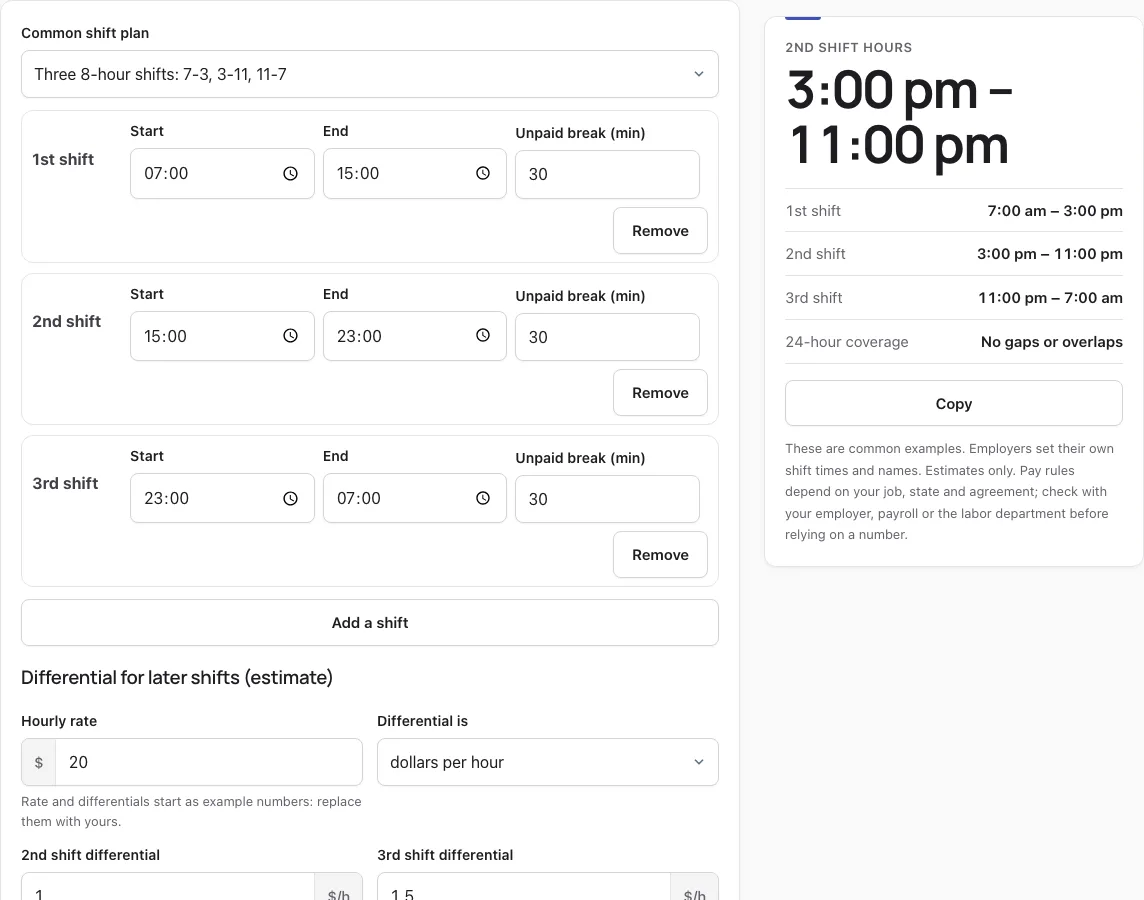
How to use the 2nd shift hours tool
- Open the Common shift plan menu and pick a preset, such as Three 8-hour shifts: 7-3, 3-11, 11-7. The 2nd shift row fills in with 3:00 pm - 11:00 pm.
- Read the times in 12-hour form in the card and table, or check the 24-hour column (15:00 to 23:00).
- To use your own hours, edit Start or End for any shift. The menu switches to My own times automatically.
- Set Unpaid break (min) for each shift. The presets use 30 minutes for 8-hour shifts.
- Read the Gap and overlap check to see any uncovered or doubled-up hours.
- Use Add a shift (up to four) or Remove (down to one) to change the number of shifts.
- Enter the Hourly rate, choose dollars per hour or a percent of base pay, then fill in the 2nd shift and 3rd shift differentials. Results appear under Differential per shift, Per week and Per year.
Your plan, rate, differentials and counts are stored in the page address, so bookmark it to return to the same setup. Other presets cover a 6-2, 2-10, 10-6 day, a two-shift 7-3 and 3-11 day and a two-shift 12-hour plan of 7:00 am to 7:00 pm and 7:00 pm to 7:00 am, so you can compare how each one places the 2nd shift and how many paid hours it leaves after breaks.
What time is 2nd shift?
In the common three-shift plan, 2nd shift runs from 3:00 pm to 11:00 pm, or 15:00 to 23:00 on a 24-hour clock. It is 8:00 long on the clock and has 7:30 paid hours after a 30 minute unpaid break. In the US it is also called swing, evening or afternoon shift.
The three presets divide the day evenly. The table below shows the 2nd shift next to the other shifts in that plan.
| Shift | 12-hour time | 24-hour time | Clock length | Paid hours |
|---|---|---|---|---|
| 1st shift | 7:00 am - 3:00 pm | 07:00 - 15:00 | 8:00 | 7:30 |
| 2nd shift | 3:00 pm - 11:00 pm | 15:00 - 23:00 | 8:00 | 7:30 |
| 3rd shift | 11:00 pm - 7:00 am | 23:00 - 07:00 | 8:00 | 7:30 |
The “What the names mean” section explains that 1st shift is usually the day shift and 3rd shift runs through the night. Hours differ by employer, so use your own schedule for real planning.
How do you check a shift plan for gaps and overlaps?
The tool treats the plan as a day that repeats, then reports every stretch with nobody on shift and every stretch where two shifts overlap. The three-shift plan of 7-3, 3-11 and 11-7 has neither. Two shifts of 7-3 and 3-11 leave a gap from 23:00 to 07:00, which is 8:00 long.
An overlap is not always a mistake. The page notes that an overlap is often a planned handover between shifts. For example, a 2-10 shift set against 7-3 overlaps by 1:00. A shift whose end is at or before its start runs into the next day, as 11:00 pm - 7:00 am does.
More questions
How is the 2nd shift differential estimated?
Enter the hourly rate, choose the type, then set the 2nd shift differential, which applies to every paid hour of that shift. At the example rate of 20 with a $1.00 differential on 7.5 paid hours, the 2nd shift is $7.50 per shift, $37.50 per week for 5 shifts, and $1,950.00 per year. These are example numbers, not a typical rate, and contracts can differ.
Does this tool calculate overtime?
No, overtime is not computed on this page. The assumptions block points to the shift differential calculator for how differentials affect overtime.
What does “Check the times” mean?
It appears in place of results when a break is as long as its shift or a time cannot be read. Correct the Start, End or Unpaid break (min) field to see the results again.
Can I change the shift times?
Yes. Edit Start or End for any shift, and the plan switches to My own times with your values saved in the page address.
Frequently asked questions
What are work shifts?
Employers split the 24 hours into blocks so that work is covered beyond a single daytime period. Each block has its own start and end time. The presets on this page show three 8-hour shifts as one common example.
What are second-shift hours?
Second-shift hours are the afternoon-to-evening hours a company assigns to its second shift. The tool’s common plan uses 3:00 pm to 11:00 pm, but your employer sets the actual times.
Are second-shift hours mandatory?
That depends on your employer’s policies and your job. Check your contract or offer letter for the rules that apply to you.
What is 1st, 2nd, 3rd, and 4th shift?
These labels show the order of shifts in a day. In the US, 1st shift is usually the day shift, 2nd shift runs afternoon to late evening, and 3rd shift runs through the night. The tool allows up to four shifts through Add a shift.
What is a 2nd shift schedule?
It is the set of days and hours a worker is assigned to the second shift, such as 3:00 pm to 11:00 pm on set days. The tool models the daily shift times and the shifts per week used in its pay estimate.
What shift is right for you?
Which shift suits you depends on your sleep, family commitments and commute. Compare the paid hours and differentials for each option before you decide.
What does “2 shift time” mean?
It usually means a day covered by two shifts, such as 7:00 am to 3:00 pm and 3:00 pm to 11:00 pm. The Two 8-hour shifts: 7-3 and 3-11 preset leaves 23:00 to 07:00 uncovered.
Why does my plan show a gap from 23:00 to 07:00?
Two 8-hour shifts of 7-3 and 3-11 cover only part of the day, so the tool reports the uncovered 8:00. The page notes this is normal for a plan that does not run around the clock.
Related tools
- Shift differential calculator: use it to work out how a shift premium affects your pay in more detail.
- Shift hours calculator: use it to total the hours for a shift you have already worked.
- Timesheet calculator: use it to add up start and end times across a full week.
- Overtime calculator: use it to estimate pay for hours beyond your regular schedule.
- How many work hours in a year: use it to see how many hours a full-time year adds up to.
- 12 hour shift schedule compared: use it to compare two 12-hour shifts with the 8-hour plans on this page.
- Rotating shift schedule: use it if your shift changes from week to week.
- Shift calendar: use it to plot shift dates across a month.