
Shift Differential Calculator
Enter your base rate, the differential and the hours it covers to see the extra pay per shift, per week and per year.
Free · runs in your browser · nothing is uploaded
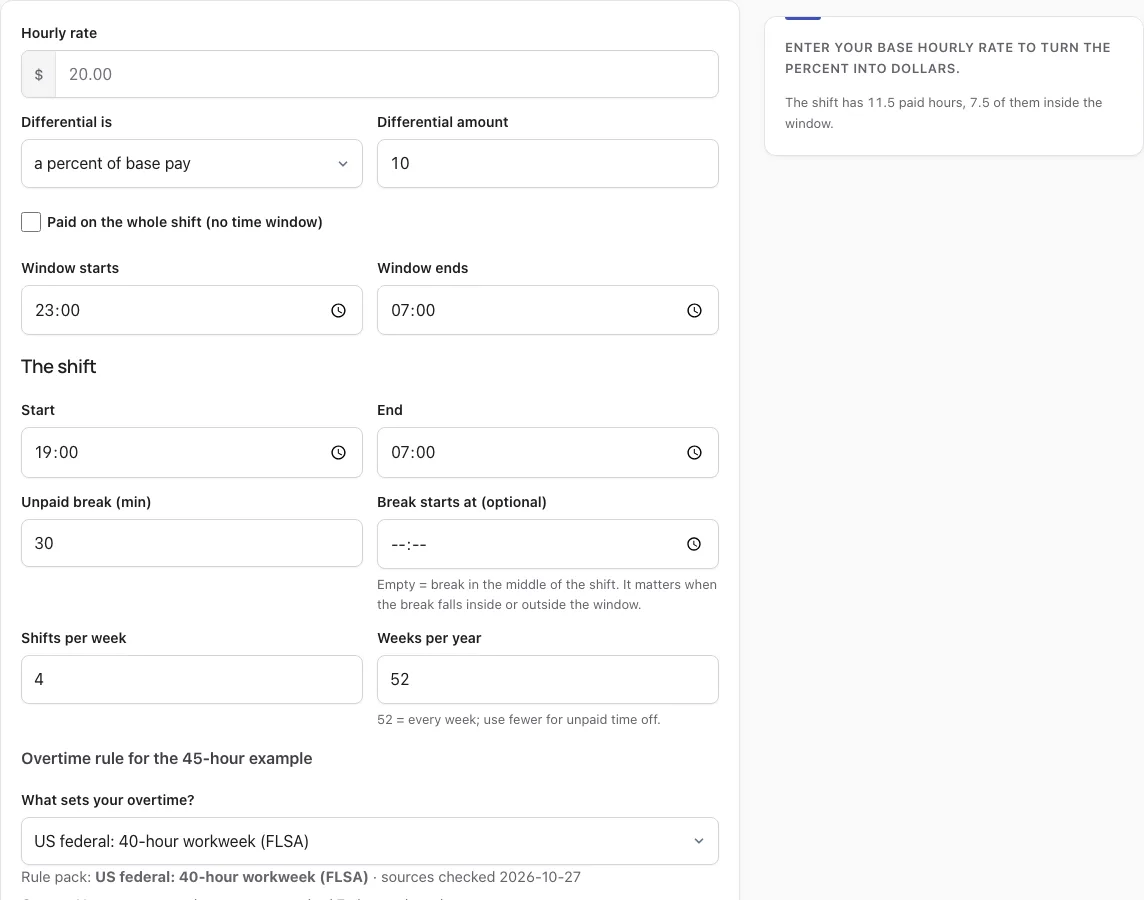
How to use the Shift differential calculator
- Enter your Hourly rate. A percent differential needs it. Without a rate, the page asks for one and shows only the hours.
- Under Differential is, pick a percent of base pay or dollars per hour.
- Type the Differential amount, such as 10 for 10% or 1.50 for $1.50.
- Set Window starts and Window ends. The defaults, 23:00 and 07:00, are only an example. Use your employer’s window.
- Enter the shift’s Start and End. The default shift is 19:00 to 07:00.
- Enter the Unpaid break (min). Optionally set Break starts at. If it stays empty, the break sits in the middle of the shift.
- Set Shifts per week and Weeks per year. The defaults are 4 and 52.
- Read the result card: Differential pay per shift, Paid hours per shift, Hours that earn the differential and Effective hourly rate on this shift, along with the weekly and yearly totals.
For a differential paid on every paid hour of the shift, tick Paid on the whole shift (no time window). The page keeps your inputs in its address, so the same setup returns when you reload it. Scroll down for an example week that shows the overtime effect under the federal and the California rules.
Is shift differential included in overtime?
Under the FLSA, yes. Shift differentials are part of the regular rate, which is the basis for overtime, as 29 CFR 778.207(b) states. The page links to that eCFR section. The example week below uses $20 an hour, $1.50 extra on every hour, and five 9-hour shifts, which makes 45 hours.
- Regular rate with the differential: $21.50 (base rate alone: $20.00)
- Week’s pay with the differential in the regular rate: $1,021.25
- Week’s pay if the differential were left out: $1,017.50
- Difference: $3.75, which is the overtime on the 5 hours at half-time
The California default pack also counts daily overtime, because each example day has 9 paid hours, which is over 8. The same figures will not match your own week.
How do I calculate a shift differential paycheck?
Multiply the extra amount per hour by the paid hours that fall inside the window, then add that to your normal pay. For a percent, first convert it to dollars by applying it to your base rate. The calculator does this minute by minute, so a break that falls inside the window reduces the differential hours.
Worked example: $20 an hour, 10% differential, window 23:00 to 07:00, shift 19:00 to 07:00, no break, five shifts a week.
- Paid hours: 12, with 8 inside the window
- Differential: $2.00 an hour, so $16.00 per shift
- Per week: $80.00
- Per year (52 weeks): $4,160.00
Now add a 30-minute break. In the middle of the shift, the break sits at 00:45 to 01:15 inside the window, leaving 7.5 window hours and $15.00 per shift. If the break starts at 20:00, outside the window, all 8 window hours stay paid at $16.00.
Can you stack night and weekend premiums?
Only if your employer or contract stacks them. Adding separate premiums is simple arithmetic, but the rule itself comes from your agreement. For example, if an agreement paid 10% for nights, 10% for weekends and 20% for holidays and let them stack, a Saturday night shift on a holiday would carry 40%. To test that, enter 40 as a percent in Differential amount, which gives $8.00 an hour on a $20 rate.
More questions
Is holiday pay 1.5 or 2x?
Employers often pay 1.5 times the rate for holiday hours worked, and some union agreements use 2 times. This calculator adds a percent or dollar amount, so enter the extra amount your agreement gives. For full holiday pay, try the holiday pay calculator.
How is the premium handled?
You choose either a percent of base pay or a flat dollar amount per hour. The note converts one into the other, so a percent shows as dollars per hour inside the window, and a dollar amount shows as a percent of your rate.
Can I share my results?
Your inputs stay in the page address, so the link reopens the same setup. The figures are estimates under the rule pack you choose.
How this tool works and where the numbers come from
The differential is added per hour as a flat amount or a percentage of the base rate. For US overtime, the differential is part of the regular rate (29 CFR 778.207(b)).
Sources
- 29 CFR § 778.207(b): shift differentials are part of the regular rate (eCFR current as of 2026-10-23) · checked
- 29 U.S.C. § 207 (FLSA § 7): overtime after 40 hours a week; § 7(j) hospitals (8 and 80); § 7(k) fire and police work periods (U.S. Code, 2023 Edition) · checked
- 29 CFR Part 778: overtime compensation (regular rate, workweek) (eCFR current as of 2026-10-23) · checked
- 29 CFR § 778.105: the workweek is a fixed and regularly recurring period of 168 hours (eCFR current as of 2026-10-23) · checked
- U.S. Department of Labor, Fact Sheet #23: overtime pay requirements of the FLSA (Revised October 2019) · checked
Frequently asked questions
What is shift differential pay?
It is extra pay for hours outside the usual workday, such as evenings, nights, weekends or holidays. It is added on top of your base hourly rate for those hours only.
What is a night shift differential?
A night shift differential is the extra pay for hours inside your employer’s night window. Set the window in the calculator to match your own schedule, because 23:00 to 07:00 is only the default example.
Is shift differential required by law?
Not under the federal FLSA. The FLSA sets overtime after 40 hours a week and is silent on extra pay for nights, weekends or holidays. Whether you get a differential depends on your employer or your contract.
What is the average shift differential?
No single average applies to every job. Pay varies by employer and industry, so the figure in your offer letter or contract is the one that matters.
What does a 10% shift differential mean?
It adds 10% of your base hourly rate for each hour inside the window. At $20 an hour, each qualifying hour earns $2.00 more.
What does a $1.50 shift differential mean?
It adds $1.50 to base pay for each qualifying hour. The note under the result card shows the equivalent percent. At $20 an hour, $1.50 equals 7.5%.
Which hours qualify?
Only paid minutes inside the window qualify. A window can cross midnight, as 23:00 to 07:00 does. A shift that only touches the window at its end gets 0 differential hours.
Is this calculator free?
Yes. It is free and needs no sign-up.
Related tools
- Overtime calculator: use it to work out overtime pay once you know your weekly hours.
- California overtime calculator: use it when your shifts fall under California’s daily overtime rules.
- Holiday pay calculator: use it to figure pay for hours worked on a holiday.
- What time is 2nd shift: use it to check when a second shift starts and ends.
- Shift hours calculator: use it to count night hours in a shift before adding a differential.
- Timesheet calculator: use it to total the hours on your timesheet for a pay period.
- How many work hours in a year: use it to see the annual hours behind your yearly differential total.
- DuPont schedule calendar and pay: use it if your employer runs a DuPont rotating schedule.