
How Many Work Hours in a Year
Pick your schedule and year to count the working days and hours exactly, take off holidays and paid time off, and convert pay.
Free · runs in your browser · nothing is uploaded
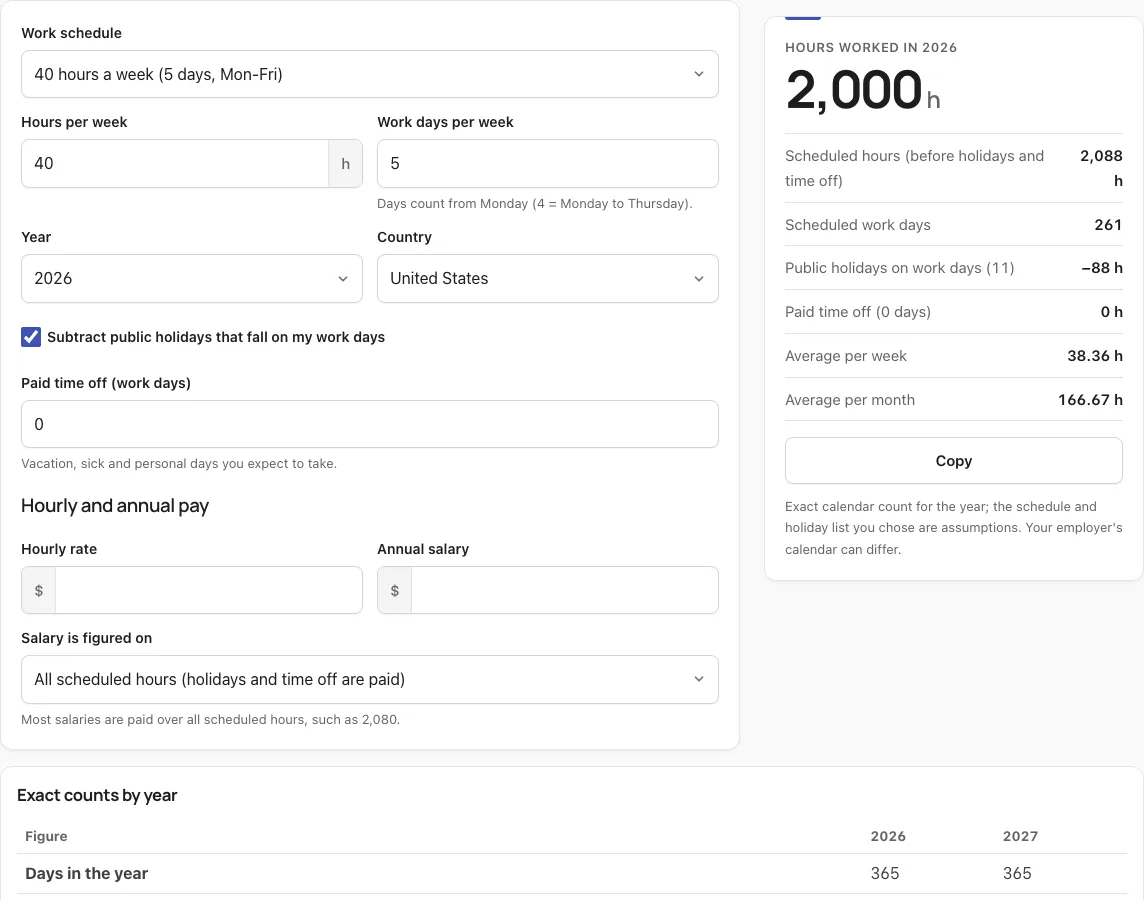
How to use the work hours in a year calculator
- Open Work schedule and pick a fixed week, such as 40 hours over 5 days, or a rotation, such as DuPont. For a custom week, choose Other weekly schedule, then enter Hours per week and Work days per week.
- Set Year to any value from 2025 to 2030.
- Set Country to United States, United Kingdom, Canada, Australia or No public holidays.
- Leave Subtract public holidays that fall on my work days ticked for weekly schedules. Rotations start with it unticked, because shift workers often work holidays. Tick it if you want holidays removed.
- Enter your Paid time off (work days).
- For a rotation, choose a Crew and set Crew A starts the cycle on to the date your crew began the cycle. Enter Unpaid break per shift if you take one.
- Optional: under Hourly and annual pay, type an Hourly rate or an Annual salary, then choose Salary is figured on. Pay figures are estimates, and contracts or union agreements can differ.
- Read Hours worked in the chosen year, then check Scheduled hours, Scheduled work days, Average per week and Average per month. The Exact counts by year table shows 2026 and 2027 side by side.
Your inputs are kept in the page address, so you can bookmark a setup or share the link. The Copy button copies the result, and the Assumptions and limits section lists what the tool assumes.
How many work hours are in a year?
A full-time worker on a 40-hour week usually has 2,080 hours in a year, but that figure is before holidays and time off. The calendar count is slightly higher: 2026 and 2027 each have 261 Monday-to-Friday days, which gives 2,088 scheduled hours at 8 hours a day.
The 2,080 figure is 40 hours multiplied by 52 weeks. The tool counts real weekdays instead, so the total moves with the calendar. 2028 has 366 days and 260 weekdays, which gives 2,080 scheduled hours at 8 hours a day.
| Year | Days in year | Scheduled work days | Scheduled hours | US holidays on work days | Hours worked |
|---|---|---|---|---|---|
| 2026 | 365 | 261 | 2,088 | 11 | 2,000 |
| 2027 | 365 | 261 | 2,088 | 12 | 1,992 |
A holiday that falls on a Saturday or Sunday removes no hours from a Monday-to-Friday schedule. In 2026, Saturday 4 July is ignored and the observed Friday 3 July counts.
How do you calculate working hours in a year?
Multiply your weekly hours by 52, then subtract the hours for paid time off and paid holidays. The usual formula is (hours per week × 52) minus ((PTO days + paid holidays) × hours per day). The tool uses the same idea, but it counts the actual weekdays in the year.
- Multiply your hours per week by 52. For a 40-hour week, that is 2,080.
- Divide weekly hours by work days to get hours per day. For 40 hours over 5 days, that is 8.
- Add your PTO days to the number of public holidays that fall on your work days.
- Multiply that total by your hours per day.
- Subtract the result from step 1.
Take 40 hours a week with 10 PTO days in 2026 and the US list. The simple formula gives 2,080 − (10 + 11) × 8 = 1,912. The tool gives 1,920, because it starts from 2,088 scheduled hours and subtracts 88 holiday hours and 80 PTO hours.
How many hours per year do other weekly schedules give?
Multiply the weekly hours by 52 for a quick yearly total. A 40-hour week gives 2,080, and 37.5 hours gives 1,950. A 32-hour schedule over four days is counted by days, so the tool gives 209 work days in 2026.
| Weekly schedule | Basis | Yearly hours before holidays and PTO |
|---|---|---|
| 40 hours, 5 days | 8 h a day | 2,080 |
| 37.5 hours, 5 days | 7.5 h a day | 1,950 |
| 36 hours, 5 days | 7.2 h a day | 1,872 |
| 35 hours, 5 days | 7 h a day | 1,820 |
| 32 hours, 4 days (Monday to Thursday) | 8 h a day | 1,672 (209 days in 2026) |
How do rotating shifts change the yearly total?
Rotations repeat on a cycle, so the tool counts the real shifts that start in the chosen year. Each shift is worth the pattern’s hours per shift, minus any unpaid break. For crew A starting 1 January 2027, DuPont gives 2,196 hours, 4 on 4 off gives 2,208 and 24 on 48 off gives 2,928.
| Rotation (crew A starts 1 January 2027, no break) | Hours in 2027 |
|---|---|
| DuPont | 2,196 |
| 4 on 4 off | 2,208 |
| 24 on 48 off | 2,928 |
The page also shows the cycle average for each rotation, which for DuPont is 2,190 hours. The gap between the two comes from where the cycle falls in the calendar.
More questions
What is the 9 9 6 rule?
It is a work pattern of 9 a.m. to 9 p.m., six days a week, which adds up to 72 hours. The tool has no preset for it, but Other weekly schedule accepts 72 hours per week over 6 work days.
How many hours are in a week?
There are 168 hours in a week (24 × 7). 40 of them, about 24%, are a standard full-time workweek.
How many hours per year if you work 37.5 hours a week?
You get 1,950 hours per year (37.5 × 52) before holidays and time off. Set Hours per week to 37.5 to see the figure after holidays and PTO for a given year.
How this tool works and where the numbers come from
Scheduled days are counted on the real calendar for the year, then public holidays on work days and your paid time off are taken out. US federal holidays follow the OPM list.
Sources
Frequently asked questions
How many full-time work hours in a year?
For health-coverage rules under the Affordable Care Act, the IRS treats 30 hours a week as full-time. That comes to 1,560 hours over 52 weeks. Your employer’s contract sets the hours that apply to you.
How many work hours in a day?
The tool starts from 8 hours a day, Monday to Friday. Across 52 weeks that averages about 173 hours a month (2,080 ÷ 12).
Do 2,080 hours include holidays?
No. 2,080 is 40 hours times 52 weeks and does not subtract holidays or paid time off. The FLSA does not require employers to give paid holidays, vacation or sick leave.
Does 2080 hours include holidays?
No, the 2,080-hour figure does not include holidays or PTO. The tool’s Scheduled hours (before holidays and time off) row shows the same kind of total for your schedule.
How Many Hours Are in a Year?
A common year has 8,760 hours (365 × 24). A leap year has 8,784 hours because it has 366 days.
What are the average hours worked per week?
The Average per week row shows the typical weekly figure for the schedule you picked, after holidays and time off. The default schedule is 40 hours a week.
How many work hours are in a year minus federal holidays?
The tool subtracts only the public holidays that land on your work days. With the US list, 11 fall on Monday to Friday in 2026, which leaves 2,000 hours worked on a 40-hour week. In 2027, 12 holidays leave 1,992.
What are work hours?
They are the hours you are required to be at work or on duty; the tool counts the hours of the schedule you pick. The tool counts the hours on the schedule you choose.
Related tools
- Holiday pay calculator: check pay for public holidays worked or paid.
- Timesheet calculator: add up hours from start and finish times.
- Overtime calculator: estimate pay for hours above your normal week.
- Shift hours calculator: work out hours for a single shift pattern.
- 12 hour shift schedule compared: compare common 12-hour rotations side by side.
- DuPont schedule calendar and pay: see the DuPont cycle and its yearly hours.
- 4/10 work schedule: check yearly hours for four 10-hour days.
- 9/80 work schedule: check yearly hours for the 9/80 pattern.